Friday, March 23, 2018

3/23/18 Intro to Art


Today's Class-  Today's topic was printmaking, the artistic mediums that include a fixed matrix that is used to create identical copies of an image, which can allow the cost per piece to be less.  Processes can include relief (woodcut. linoleum), metal plates (etching, engraving), lithography (stone), silkscreen, etc.  We used slides to get an overview of such artworks.  
Our portfolio exercise today involved a more modern print process, the collagraph, which encompasses a number of materials collaged to a flat surface, with ink applied in a variety of ways, and different possibilities for printing.  I chose a process that is simple and inexpensive- plates made from thin cardboard, and found object scraps attached with white glue.  Printing will come in a few weeks.


How to make this up- If you attended class today you may have what you need, although the option exists to add more to your plate before we print them.  If you missed today, you have to do it all on your own.  Here are some student examples from previous semesters.


Each of these sets shows the plate that was used to print the image, and the resulting image. The ink is water soluble black relief ink, applied with a roller.  Note that the printed image is a mirror image of the original, so if you want your print to include letters or numbers, you'll have to make them backwards on the plate to print forwards on the paper.  Also note that the ink is black and that the color of the materials in the plate have nothing to do with the color on the print- it will all print black.  Students do have the option of adding color to the finished print as in the bottom example above- once the ink is dry, color can be added over the top by watercolor, thin pastels, colored pencils, etc, without eliminating the texture in the original print.

Start with a piece of thin cardboard, the large panel of a cereal or cracker box will do fine.  Create some kind of recognizable image out of scrap materials and glue it to the cardboard surface.  In class I provided a lot of different kinds of cloth, but I showed examples including such things as yarn, leaves, candy wrappers, paper towels- a thin coating of diluted white glue will keep them more stable.  The one rule I have is that 8 different textures must be in the final print, and the above examples show how different materials can print different textures.  I do advise not using cotton balls- they seem like they would have interesting results, but the ink doesn't stick to the cotton, but the cotton sticks to the ink, makes a big mess.

Homework- If you didn't complete your plate in class, get it finished by April 13th, 3 weeks from today.  On that day I will bring in the ink and tools to print them in class.

The majority of students in both classes turned in the museum assignment yesterday.  Those will be returned graded at our next meeting.  If you didn't do it yet, I will accept them late, but point deduction will increase with each week you miss.

The other written assignment, your research paper, is due April 27, 2018.  

***Kean is closed on March 30, 2018***
   **********No class that day***********

For next class April 6, 2018- We will start the first individually graded art project of the semester, which will involve two weeks in class and you'll get another week to finish it on your own.  Bring your 18"x24" drawing pad, pencil and eraser, and your pastels.


Friday, March 9, 2018

3/9/18 Intro to Art


Today's Class- The topic today was rhythm, which we usually associate with music, but there is a visual equivalent that can be found in art.  I showed a few dozen art historical slides, paying attention to times that artists used visual rhythms in their pieces.  Then we did a portfolio exercise that involved watercolor paintings that were influenced by types of music playing while the were painted.

How to make this up- You will need your 18" x 24" pad, watercolors, brushes, and a water container.  Palette is optional, but you can use your colors as they are manufactured and don't need to mix them.  However, you can use the paint any way you want.  You will play different types of music, 15 minute segments, and do abstract paintings in reaction to the music you are hearing.  Below are some student examples from previous semesters.


More student examples and information about the music that was used (or how to substitute) can be found here.

This is a portfolio exercise and can be made up any time before the end of the semester for full credit.


Homework- The first written assignment, the museum paper, is due at the beginning of class on March 23, 2018.  

*****Spring Break 3/12/18 - 3/18/18*****
******No class meeting next week*******

For next class 3/23/18- We will start a multi-week project related to printmaking, a collograph print.  This involve making a printing plate by attaching items of various textures to a flat surface, rolling it with relief ink, then printing it.  Here is an example of student plate and print from a previous semester.

I will provide the cardboard to make the plate, and a variety of materials that can be used to collage your image.  You need to bring scissors and glue (white glue is best) and are welcome to bring additional material to glue to the plate.  (materials should be relatively thin, have some kind of texture)  The glue needs time to dry and these will be printed another week, so you can leave your big pads at home that day.


Friday, March 2, 2018

3/2/18 Intro to Art


Today's Class- Today's topic was photography, a relatively recently created artistic medium with long ago roots.  It begins with the camera obscura, a tool known around the world to many ancient peoples, but well developed in the baroque period.  In the 19th century, modern chemistry knowledge allowed people to preserve the projected images in a more permanent form, thus inventing photography.  I showed a few dozen slides of photo based work, ranging from the earliest experiments to the contemporary, covering the evolving technology and the many uses it is put to in art. For many people film has been replaced by digital technology, but the art part is pretty much the same. 

I distributed a take home assignment, and we took a tour of Vaughn-Eames, checking out any studios and galleries that were open and seeing what kind of stuff goes on in an art building.

How to make this up- I gave out a handout with a list of 20 photos to be taken, on your own time.  This is a portfolio exercise, but the plan is to share the results with the whole class.


For more details on the assignment, as well as student examples of each part, click here.

Homework- The photo assignment is a portfolio exercise, but I'd like to see them all by April 13, 2018, so we can share the results with the whole class.  They can be printed on any kind of paper, and don't need to be mounted, but just label them so we can easily see which part of the assignment they are for.

The museum assignment is due on March 23, 2018.


This afternoon, Kean University announced they were cancelling all remaining classes today because of the weather.  They waited until after we were done to announce this.  I've had worse rides home from school, and I hope you all got home safely.  Weather predictions for next week are better.

For next class 3/9/18- We go back to color, this time more expressive than the theoretical stuff we dealt with last time.  Bring your 18" x 24" pad, watercolors, brushes, and a water container.  You may use all the colors as they are in the kits, but if you think you may want to mix colors, be sure to have a palette.  

Friday, February 23, 2018

2/23/18 Intro to Art


Today's Class- Although we dealt with a few aspects of it last week, today we began color for real, exercises related to color theory.  I talked about the scientific nature of color, sources of color for art purposes, and then showed a few dozen slides related to the history of color in art, both painting and sculpture.  Then on to the exercises.  We used watercolor to make a 12 hue color wheel, and do an exercise in complementary color mixing.


How to make this up- Below is an example of the kind of thing we did today.  Everyone completed a color wheel, using primary, secondary, and intermediate colors.  The second part was selecting a pair of complementary colors and an exercise that involved mixes and tints of those colors.


Detailed instructions and another student example can be found here.

Homework- No new homework.  However, we are about to enter March, so keep in mind the museum assignment will be due in a few weeks.

For next class 3/2/18-  Next week's topic is photography, and we'll be looking at many examples of the history and uses of photography over the past few centuries.  The exercise will be something you take home to work on, so you don't need any art materials for next week's class.  I will distribute the assignment in class next week.  I will use a chunk of the remaining time to take us on a tour of the building, as many of the studio classrooms as are open, and perhaps the student show in the gallery downstairs as well.

Friday, February 16, 2018

2/16/18 Intro to Art


Today's Class- Today's topic was monumental art, which I define as large scale art that is permanently part of a building or public space.  I showed a few dozen slide examples, starting with cave painting, then moving through Etruscan, Roman, Byzantine, Gothic, and the Renaissance, and such mediums as paint, fresco, mosaic, and stained glass.  Today's art project was a variation on the idea of mosaic, a collage using small pieces of colored paper to build an image.

How to make this up-  You will need to select a color photograph of a 3 dimensional object or scene.  What it is doesn't matter.  You will do a basic pencil line contour sketch of the image, including all background items.  The drawing will either be 6" x 6" or 4"x 9" (vertical or horizontal) so make a box like that in pencil.  In reproducing the original photo, you may crop it, draw it at 100% scale or enlarge a small area, but everything that would fit into your box must be included.  Then use colored paper from magazines to match the colors in your original photograph.  The color pieces should be no larger than 1/2" square, but may be smaller.  Pieces of paper may overlap, or have a small white space between them.  Some student examples from previous semesters can be seen below, both original photo and student mosaic-


 This is a portfolio exercise and must be completed by the end of the semester for full credit.  

Homework- Nothing new, but keep in mind that you have two papers to work on, the first of which is due in late March.

For next class 2/23/18- We continue our study of color, this time with some basic color theory.  Bring your 18"x 24" pad, pencil and eraser, watercolor paints, watercolor brushes, mixing palette, and a container to hold water.

Friday, February 9, 2018

2/9/18 Intro to Art


Today's Class- Today's topic was the formal issue of value, use of relative tones of dark and light in art.  This can serve many purposes- description of areas, implying three dimensional form, creating space, focusing attention, establishing time of day, etc.  I showed about 2 dozen slides of historical art, pointing out the ways light and shadow were used by the artists, then we got on with the portfolio exercise of the day- a value drawing using charcoal.

How to make this up- I set up a simple still life in the center of the darkened classroom, with an overhead spotlight shining on it.  The still life consisted on a stool with a white bed sheet draped over it, and on and around that several simple objects, all painted white, so that local color values would not be a factor.  Today it was just about light and shadow.  Below are a few examples of typical student charcoal drawings from previous semesters.


To do this on your own, put a box on a low table, drape it with a white or light colored cloth, and place three white or light colored objects on or around the box so all can be seen.  Use a single light source to created patterns of light and shadow.  Draw the still life on a sheet of your 18" x 24" paper, including  all three objects, and any of the white fabric seen in your view.  Try to match the shapes of your objects and the light and dark shapes as closely as possible, not forgetting what we learned about negative space.  Spend up to 90 minutes on it.

Homework- Nothing new, but keep in mind that the museum assignment is due March 23, 2018.  Plan accordingly.


For next class 2/16/18- The topic will be monumental art, which I am defining as large scale art that is permanently part of the location.  A common medium that goes back to antiquity is a mosaic, a two dimensional image made up of small bits of stone, glass, ceramic and other bits, arranged to form some kind of image.  We will be doing the same thing, but using paper to make the images.  You will choose a color photograph from a magazine, sketch the basic shapes with a pencil, then use small cut up pieces of paper from other magazines to reproduce shapes and colors from the original image.  Everything will be glued to a page in you big pad.  Below is a student example, with the original image on top, and the collage version below.


Bring your 18"x 24" pad, pencil and eraser, scissors, and a glue suitable for gluing paper to paper.  I will bring a pile of old magazines, but if you have some you don't mind cutting up and want to contribute them to the pile, feel free to do so.

Friday, February 2, 2018

2/2/18 Intro to Art


Today's Class- Today we continued with line, doing exercises related to the idea of negative space, which is all the space around the positive shapes in a drawing.  Since the two define each other, they are equally important in drawing.  Also today the topics for the research assignment were picked.


How to make this up- The class completed two portfolio exercises; everyone present did them and will get the full credit for them.  First I set up an old wooden desk chair and had the students draw all the negative spaces, the empty spaces surrounded by wood.  Second, I set up a still life of assorted bottles and had the class draw the positive shapes of the bottles, but using negative space to check spacing and locations, as in the student example below.


More examples and specific instructions on how to make up the assignments can be found here.

Homework- Students picked the topics for the research assignments today, the second written assignment.  There are more possible topics than students in the classes, so if you don't have one yet, you will have options.  Talk to me next time you come to class.  The written assignment isn't due until April 27, 2018, so you have time.  The museum assignment will come sooner.


For next class 2/9/18- We move on to the design element known as value, which is the use of light and dark in art.  We will be using charcoal to do some value drawing.  Bring your charcoal, kneaded eraser (absorbs dust- ideal for charcoal), and 18"x 24" pad. I'll provide the subjects for the exercises. I recommend that you wear black or dark colored clothes- charcoal is very dusty.  It washes out, but short term you don't want to look dirty.

Friday, January 26, 2018

1/26/18 Intro to Art


Today's Class- Our main topic today was the line, one of the most basic units of all art.  We had a brief discussion of some of the many ways line can be used, then looked at a few dozen slides of historical art, all of which used line in a significant way.  That was followed with some exercises in contour line.  Toward the end of class I distributed the museum assignment that I couldn't copy last week, and quickly reviewed it.

How to make this up-  Today was a portfolio exercise, so the work will be graded as part of the semester portfolio.  If you were there and did everything, you will receive full credit.  If you missed class, you have until the end of the semester to make it up, but those who wait until the end usually never get around to it.


All exercises involved drawing from shoes, a classic student drawing exercise.  The details of the assignment, and student examples from previous semesters, can be found here.

Homework- The museum assignment has now been distributed to the classes.  If you missed class today, you can get a copy next week, or see a simplified version by clicking the museum assignment link at the top of this page.

For next class 2/2/18- More lines, but this time we will look at the idea of positive and negative space, which are important for composition and for rendering groups of objects.  Once again bring your 18"x 24" paper, pencils, and eraser.  I will provide the subjects for the exercises.  There will be no shoes.

Friday, January 19, 2018

1/19/18 Intro to Art


Today's Class- Today was our first meeting of the semester.  No one has materials yet, so we didn't do any art exercises.  I did distribute and review the syllabus.  A lack of copy paper in the department office meant that I couldn't copy anything else, so we did the student art survey as an oral exercise and the written version of the museum assignment will have to wait for another week.

How to make this up- Nothing to be made up, except that those who missed class today should make sure to ask me for a syllabus next week.

Homework- No homework yet.  The museum assignment will be due at the beginning of class on March 23, 2018.  I hope to have the full 2 page version available to distribute next week.  If you can't wait until then to see it, the link above labeled "museum assignment" will show you the basics.

For next class 1/26/18- We will start the fine arts portion of the class with a portfolio exercise involving line.  After looking at some art historical examples of line in action, we will concentrate on the idea of contour line in its various forms, using shoes as our subject.  I will have some, but I recommend you bring one of your own to draw from, which you could take off your foot, but you are probably better off bringing an extra with you to class.  Also bring your 18" x 24" drawing pad, pencils, and eraser.

Thursday, January 18, 2018

Welcome to the Spring 2018 Semester


This is the blog site I have set up for my classes at Kean.  This semester I have two sections of Introduction to Art (FA 1000), both on Friday, so these posts will cover both classes.  Each week I will put up a post the evening following those classes.  The title will include the class and date.  Text relating to the class will be in red.  Any posts about school stuff or other related items, but not specific to our class meetings will be in black.  

Each week I will post a brief description of the day's events, including photos (if available) of the kind of projects people worked on that day.  I will include instructions for the assignments.  All work must be completed by the end of the semester, but on those occasions that things are due sooner, that will also be listed.  I will also include information about the following week, such as materials needed.  Art materials will vary from week to week, and I'll let you know in class what will be needed for the following week, but it will also be here.  The home page includes information about our written assignments, and links to museums.

This online site is not a substitute for coming to class.  It is meant to provide information to registered students who usually attend class, but may have missed a meeting, so they can be caught up quickly.  But even if you miss a class meeting, this site may be useful to remind you of what we've done, to check the list of materials for next class, to verify a deadline for a graded project, or to see completed student examples.  It is available 24/7 and most of the questions that students have will be answered by information here.  However, if you need additional information or explanation, you are welcome to e-mail me directly and I will usually get back to you within 24 hours.

Friday, December 22, 2017

12/22/17 Intro to Art


Today's Class- Today was our final meeting of the semester.  The snow held off, and parking wasn't a problem, with the Vaughn-Eames lot empty early in the morning and never more than half full all day.  And we had some of our best attendance of the semester, perhaps driven by the need to turn things in for grading.  The main class activity was looking at the 3D graded projects, plus getting the portfolios reviewed.

How to make this up- All work was due by the end of our class meetings, so if you didn't turn it in today and made no other arrangements, you're out of luck.  Most students turned in their 3D graded projects, with many finding very creative ways to make use of their randomly chosen topic.  Here are just a few examples:


A whole lot of papers came in today as well, both handed in as hard copies or e-mailed to me, far too many for me to evaluate during class time.  I'll start looking them over tomorrow and probably finish shortly after Christmas.  Any papers arriving today will be graded as 'late', but that's better than not at all.  

Most students brought in their large pads so that I could review the semester portfolios, and the exercises were all checked off in my records.  A few late arriving comic strips were also evaluated. 

Homework- As I said above, if you didn't turn it in by today's class, it won't be graded.  I will continue evaluating the papers and after that, start adding up the numbers to determine the final semester grades, which I believe are due sometime in January.  I will turn them over to the university as soon as I have them all figured out.  

If you enjoyed anything that we did, there's no reason you can't try those processes again on your own, and most of you probably have some left over materials to work with.  

Enjoy the break.


Friday, December 15, 2017

12/15/17 Intro to Art


Today's Class- Today was a general work day.  A few students turned in papers, and one even showed her 3D final project, while some worked on portfolio stuff or their 3D projects.  People who missed last week drew words for their 3D subjects. We saw the last slides of the semester, a very brief overview of three dimensional art through history.  People left early from both classes, which was probably a good idea in the afternoon, when the snow showed up shortly after the last student left.  That I'm writing this is a sign that I made it home, but that happened just barely.  Long range forecasts for next Friday are looking better, but we'll see.


How to make this up- Nothing new happened today, so if you have anything to make up it's whatever you needed to make up before class.


Homework- The graded 3D project (randomly chosen subject sculpture) is due at the beginning of class on December 22, 2017.  If you haven't yet picked your words from the hats, you should e-mail me and I'll send you two possibilities to choose from.

Any 2D projects (comic strips) and papers not yet turned in are also due that day, as are the completed portfolios- list of expected work can be found in last week's blog post.


For next class 12/22/17- Our final meeting of the semester. Each student will present their 3D project to the class, and then we'll do all the grading .  Things that have already been graded and returned to you don't need to come back, but you do need to bring in everything part of the class portfolio, the 3D projects, any late papers, etc.  It's also your last chance to turn in any excused absence notes you may have.  No work will be accepted after the official end of class.  At the end of class you'll know the grades for every assignment, but final semester grades will be calculated after the holidays.


Friday, December 8, 2017

12/8/17 Intro to Art


Today's Class- We did some little things today, such as filling out the class evaluation forms, but our main new art was beginning the 3D graded project, our last new thing of the semester.  We finished a little early, but not early enough to avoid the delays associated with the freight train derailment right by the campus.

How to make this up- Each student received a randomly selected phrase with both a subject and modifying phrase, which will form the subject for the last project, a three dimensional representation of that idea.  Each student will create a sculpture that depicts their chosen concept.  Below are some examples from previous semesters, including the phrase that inspired each:

 Appetite for Distraction

 Fallen Merchant

 Impasse Changed

 Planet Gone Wild

 Plowing Through the Nation


Troubled Uprising

Each student picked slips of paper from two hats, one filled with nouns, the other with modifying words or phrases, all the words taken from headlines of book reviews in the New York Times.  The randomly created new phrase will form the subject for your piece.   You may use any process and materials you want to create the sculpture, including making use of ready made objects, although the sculpture itself should be something you designed and made.  The piece may be freestanding, or can be designed to hang on a wall with an open front, as in some examples above.  It must be at least 8" in one dimension, but overall can be any size you want.

The first step is to get your phrase.  If you missed today's class, you can either wait until next week and draw a possibility yourself from the hats, or you can e-mail me sooner and I will pick two possibilities for you, one of which you must work with.  The advantage of having me do it sooner is that you have time to come up with your idea of what you want to do and acquire chosen materials to bring to class next week.

Homework- This final 3D graded project is due December 22, 2017, our final meeting of the semester.  On that day you'll present it to the class.

That is also the last day to turn in anything else you may still owe me, such as the last paper if you hadn't done it yet.  That same day I will also evaluate the semester portfolios- all the in class exercises you've done all semester.  If you've missed no classes, you've at least started all of them, and may have finished all of them.  However, if you'd like to verify what I'll be expecting, here's the complete list and where you'll find them on this blog:

9/15/17-  Contour Lines (shoes)
9/22/17-  Negative Space (chair, bottles)
9/29/17-  Value (charcoal)
10/6/17-  Collage/Mosaic
10/13/17-  Color Theory (Wheel) and mixing
10/20/17-  Photography
10/27/17-  Rhythm 
11/3/17-  Collograph print (texture)
12/1/17-  Two point Perspective


For next class 12/15/17- Next week will be a general work day, which you can use to work on anything from the class.  We will see the last slides of the semester, an overview of sculpture (which could be helpful to your process for the last project) but otherwise you'll be working on whatever you need to do for the class.  Many of you will work on the 3D graded project, but some of you may want to take advantage of the time and space to work on one of the above portfolio exercise, or you can even bring a computer and work on your last paper for the class.  Therefore bring with you whatever you need to work on whatever you have decided to work on.  

Thursday, December 7, 2017

Research Assignment


We had a request to have the specifics of the research assignment for the 1000 class posted to this blog, so here it is.  It will appear in the list of what we've done, and I hope to set up a link directly to it from the list at the top of the right column.

Research Assignment

Each student is responsible for researching a particular movement in western art, the topics to be chosen by a method listed in the assignment sheet.  A written report will be produced containing the following information:

*The names of three prominent artists from this group (painters, sculptors, architects, printmakers, photographers, or whatever is significant to that group)

*For one work by each artist you will follow the Feldman criticism method we are using for the museum assignment.  (description, analysis, meaning, and judgement)  Although you may expand beyond it, your analysis should include the answers to these questions for the whole artistic movement:

   1) What were/are the goals of this art?
   2) How is the art of this period different from that which 
       proceeded it in its society?
   3) How does this art reflect its society?

The written report must be typewritten or computer printed, and should be a minimum of two pages.  You must cite bibliographic sources.  Books are generally more reliable than the internet for research, but under the current circumstances, use whatever you must.  

These are websites that may have some relevant information, including lists of artists and artworks that are parts of various movements, but you are not limited to these:

https://artsandculture.google.com/partner

https://artsandculture.google.com/explore


Friday, December 1, 2017

12/1/17 Intro to Art


Today's Class- Today the class completed the last portfolio exercise of the semester.  After viewing a few dozen slides of the history of architecture, we did something related- perspective drawing.  Perspective is the use of formulas and procedures to draw a three dimension space in a way that provides a regular system of distortion, but one that makes sense in art.  Developed during the renaissance, it's main use was to portray the inside and outside of buildings, so it relates to the idea of architecture.  We also looked at all comic strip that came in today in a critique format.  Here are some examples from today:


How to make this up- The process of perspective drawing is fairly complex, too much so to easily explain here.  Below is an example of the assignment from a previous Kean student, drawn in a room very similar to ours.


If you know how to draw in two point perspective, you can make this up by choosing an interior corner of any room, using a page in your 18" x 24" pad, and pencil of your choice.  Your drawing should include the corner, floor and ceiling lines, two items that are part of a wall (such as a door, window, poster, etc) and one small piece of furniture.  If you are unfamiliar with the process, I suggest you wait until you return to class and ask me about it.

Homework-   The second written assignment is due next week, December 8, 2017.  For most people that will be the museum assignment, but if you did that for last month's paper, then you owe the research assignment.  

If you did not turn in your comic strip today, try to get it done for next week.  It's a graded assignment, so the longer it takes to finish, the lower the eventual grade will be.

If you were not present when we printed the collograph plates, you should bring it in as soon as possible.  I won't be bringing all the printing stuff each week, but I will collect what comes in and print the in my studio over the weekend.  I took home three such plates today.  Here's what came when I printed them-


I can't help you out on the last day of class, so you should get it done for the weeks before out last meeting.

For next class 12/8/17- I'll return the comic strips and more papers, and we'll begin the final graded project of the semester, our 3D final.  You'll be getting subjects that are randomly created and assigned and will be able to make use of any materials you want.  For next week I suggest having a place to make notes and sketch your ideas.  A small sketchbook or notebook will suffice, but you may use your large pad if that's all the paper you have, plus pencil and eraser.

Friday, November 17, 2017

11/17/17 Intro to Art


Today's Class- Today we had two main activities, continuing work on the symbolic autobiographical comic strip that was started last week, and we printed the collagraph plates that were created in class two weeks ago. Some of the papers turned in last week were returned.  No new slides today, since the project in class was the same one related to the narrative slides looked at last week.

How to make this up-  As far as the comic strip part of the day, if you were in class last week, you already know what to do. If not, last week's blog post should explain it all. Some students who missed last week got to have me explain the project directly to them, showing the student examples I have saved in recent years.  

The majority of students present today brought in their completed collagraph plates.  I had brought in some newspapers to protect the table, a portable glass palette, brayers, wooden rubbing tools, and black water-based relief ink, and we used some of the paper from the large pads to print those plates.


I probably won't be bringing in all the printmaking stuff again, so as in previous semesters, I'll ask that anyone who wasn't prepared to print today bring in their plates to class as soon as possible, and I will take them to my home studio, print them, and bring the results back to class.


Homework- The completed comic strip project is due at the beginning of class on December 1, 2017.  This is the first individually graded project of the semester.  We will look at them as a group and I will collect them.

Students who have not yet turned in their first paper should do so as soon as possible.

  *******Next week is Thanksgiving********
  ******Kean will be closed on Friday******
  ********No class for us next week********

For next class 12/1/17- Getting near the end, only four meetings left after the holiday.  We have one last portfolio exercise, involving architecture and perspective drawing.  Bring your 18"x24" pad, pencil and eraser, and some kind of straightedge, like a ruler or yardstick.  I will have some, but not enough for everyone to have their own, so if you don't bring one you will have to be sharing. 

Friday, November 10, 2017

11/10/17 Intro to Art


Today's Class- Today we started on the first individually graded project of the semester, our main 2D project.  The topic that we are addressing is narrative, or the way that art can be used to tell a story, which has often been part of visual art.  In fact, other than parts of the mid-20th century, most western art has been about telling stories.   We looked at the Bayeux Tapestry (which may be the world's first comic strip), plenty of examples from the Renaissance, Baroque, Academic, and early modernism, for which the story played an important role.  We also looked at pieces that relied on viewers' knowledge of mythology and symbolism to make their points.  Then we moved on to the project itself- an autobiographical symbolic full color comic strip.


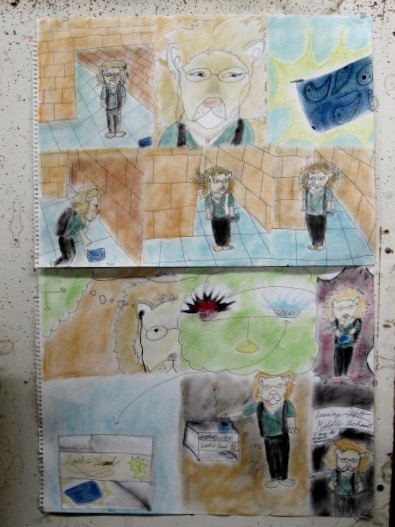
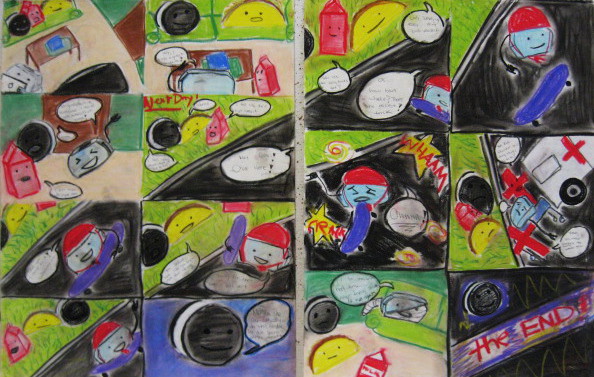
How to make this up- One of the inspirations for this project was Art Spiegelman's 1970's/80's comic book Maus, which simultaneously told two stories about his father- one recounting his parents activities in the 1930's and 40's, victims of the Nazi concentration camps in Poland, and the other story about dealing with his often difficult elderly father, now living in New York.  As in that example, students are being asked to tell a true story from their life, using symbolic characters (see the above Maus link for more details) Below are some student examples from previous semesters- click on the images to enlarge:


The comic strip should use two 18" x 24" pages from your large pad.  Each page should include 6 panels (can be more if you want), which can be identical in size or vary if needed.  Pages can be horizontal or vertical.  I recommend working out ideas for the 12 panels before starting, and you may use pencil to sketch out the layouts first.  Pens/markers can be used to write text (such as dialog balloons, thought balloons, or caption boxes) and even to outline objects, but otherwise the art should all be in full color (things that one might expect to be white may remain so) from pastels.  All character will be symbolic, the symbolism either relating directly to the individuals, or to the subject of the story.  

The nature of the story can be significant or inconsequential, and can take place all at once, over a period of years, or any amount in between.  


Homework- Nothing new, but some students still haven't turned in a written assignment yet, so get one of those done. People who have completed the photo assignment should bring those in to share.


For next class 11/17/17- We will continue work on this comic strip project, so bring in your 18" x 24" pad, pencil and eraser, and pastels.  We will also be printing the collagraph plates made in class last week (cardboard, cloth, etc), so bring those as well.  I'll provide the ink and printing tools, the paper will come from your large pad.  We'll take care of those while students are individually working on their comic strips.  The completed comic strips will be due the week after our Thanksgiving vacation.