Friday, March 22, 2019
3/22/19 Introduction to Art
Today's Class- Today's topic was the idea of rhythm, which can be applied to visual art as much as sounds. I talked a little about how rhythm can be found in relationships of shapes, colors, marks, spaces, objects, and other things that can be described visually, using terms that we use in describing audible rhythms that we might hear in music. Then the class did a portfolio exercise relating to the idea of visual rhythm, involving making visual representations of musical rhythms- or art based on sounds we hear.
How to make this up- I played recordings of various musics for the class, and had the students use watercolor paints to interpret the sounds visually, in the form of abstract representations of what they were hearing. They could choose any colors, shapes, or visual characteristics that they wanted, as long as there were no recognizable images of things. Here are some examples from past students:
Additional examples and the specifics of the class exercise can be found here.
This is a portfolio exercise that can be made up for full credit any time before the end the semester.
Homework- Nothing directly related to this assignment, but I reminded everyone that the rough draft of the museum assignment, our first graded item of the semester, is due at the start of our next class meeting- 3/29/16. I handed out additional copies of the museum assignment to anyone who needed one, and there is a simplified list of the questions available on this blog by clicking on the "museum assignment" link at the top of the home page. That also brings up a list of the pre-approved museums and active links to their websites. As with any graded assignment, there are penalties for submitting things after the deadline.
For next class 3/29/19- We are starting a new portfolio exercise, our last new one before the first graded art project of the semester. This next exercise relates to printmaking, a general medium that makes use of a created source to produce art. The class will be creating collagraphs, a printing plate built through the collaging of textural materials, which will eventually be rolled with ink and printed. This can't be done until the glue holding it all together is dry, so that step will have to wait for a later week. Meanwhile, here is an example of a collagraph plate and a resulting print. Note that the colors of the objects used to make the plate have no effect on the resulting artwork.
I will provide cardboard for the plate base and bring in a variety of materials that students may cut up and attach to the bases as part of creating their plate. The printing part of the process will be done a few weeks from now, so students will have the opportunity to add additional elements that could result in a preferred printed image. For next week bring scissors and white glue, with flat items possessing textures an option. We don't need the large pad of paper, so you can leave those home if you prefer.
Friday, March 8, 2019
3/8/19 Introduction to Art
Today's Class- Today our topic was photography, a relatively recent medium with roots in antiquity. The ancients were aware of a device called a camera obscura from the Italian words for "dark room". It allowed a three dimensional scene to be projected onto a flat wall, and artists could trace the scene onto a canvas or panel as part of the painting process. However, many sought a way to affix such images directly to paper without the aid of an artist, and advances in chemistry and lens design eventually made this possible.
We looked at slides of the history of photography, from the early experiments of the 1820's to the late 20th century, and discussed some of the many ways it was used in art. I distributed a written take home assignment in this medium, and showed student examples of the assignment from last semester to help explain the idea. After that we left the classroom and worked our way down to the 1st floor of Vaughn-Eames, visiting classroom studios and the student art show along the way. We dismissed from the 1st floor.
How to make this up- The photography exercise is a take home assignment, a list of types of photos that need to be taken, though there are many choices of subjects. Students who were not present today can see examples of the exercise here, and can get the written version at our next class meeting. I can also show you the same photo examples from last semester that students looked at today.
Homework- The photography take home assignment is a portfolio exercise, and can be made up at any time for full credit. However I did put a deadline of April 26, 2019 on the assignment, just to encourage students to get it done sooner, and allow your classmates to see what you came up with. Besides, you'll have other things in this class (and likely your other classes) due at the end of the semester, so it's best not to have to deal with this at that point.
The photos need to be printed on paper, but it can be on photo paper or just on computer printer paper. They can be black and white or color, and you may use a cell phone camera if that is what you have. This is more about subjects and interpretation than it is about camera technique.
The first draft of the museum assignment is due in class on March 29, 2019. All the information is available by clicking the "museum assignment" link at the top of the blog home page, including active links to the pre-approved museums. If you wish to go to another museum, e-mail the information to me and I'll let you know.
****Spring Break March 11-17, 2019. No class meeting that week.****
For next class 3/22/19- We will go back to color and the watercolors, with a more expressive portfolio exercise than the color theory stuff we did last time. Bring your 18"x24" pad, watercolor paints, brushes, a water container, and a palette if you wish.
Friday, March 1, 2019
3/1/19 Introduction to Art
Today's Class- We got back to color today with some basic color theory. The class used watercolors to do two exercises that involved color mixing, using watercolors. We also looked at some slides from art history, a brief look at how color has been used over the years, discussing sources and purposes of color.
How to make this up- The two exercises involved creating a 12 step color wheel, and mixing a set of complementary colors to create various neutrals.
Detailed instructions as to how to do these exercises, and an additional student example, can be found here.
This is a portfolio exercise and can be made up for full credit any time before the end of the semester, but color will be used again, so this experience will be helpful. The watercolors will return again in a few weeks, in a rhythm related assignment.
Homework- Nothing new today, but I'm reminding you that the first draft of your museum assignment is due on March 29, 2019, now less than a month away. I recommend going on your museum visit soon if you haven't done so yet. Information about the written assignment can be found in the link at the top of the blog home page. There are also links to the home pages of the pre-approved museums list, for quick access to a list of shows, hours, fees, policies, etc.
For next class 3/8/19- Our topic is photography. In class we will look at slides covering the history of photography, which starts with experiments hundreds of years ago, and really gets going in the 1800's, and continues into our lifetimes. A related portfolio exercise will be completed on your time, from an assignment I will give you on paper in class, so you do not need to bring any materials to class next week, the only time that will happen this semester. A chunk of the remainder of the class meeting time will be used to take a tour of the building, with looks at any studios we can get into that day and the current student art show in the gallery.
Friday, February 22, 2019
2/22/19 Introduction to Art
Today's Class- Today was our first exploration of color. We eased in with an exercise that dealt with color matching, along with continuing our experiences with shapes, and introducing the medium of collage, and exposure to the concept of mosaic.
How to make this up- Start with a color photograph of something that exists in 3 dimensions. (such as an object or a scene) The source can be anything you want, but if it is digital you will need to eventually print it out so it can be compared to your artwork. I provided cardboard templates of the minimum sizes- 6"x6" and 9"x4" (both 36 square inches), whichever shape makes more sense for your artwork. You may make something larger than either of those if you choose- it is your artwork in the end. You may crop your original photo and choose a portion of it to be in your new piece, but you must include everything in the portion you choose to depict. Do a line sketch of the object or scene, large enough to fill the chosen minimum box, drawn on a page in your 18"x24" pad. This piece will be more about color than anything else, but the more accurate the drawing, the easier it will be to match color shapes.
With the drawing completed, it's time to find the colors. Go through old magazines, matching the colors from the original photo as closely as possible, including value changes. Cut color pieces to a maximum of .5" square, though they can be any shape smaller than that. Arrange them to fill the equivalent spaces in your drawing that they do in the source photo, and glue them in place with the adhesive of your choice. There may be slight white space between them, or pieces may overlap. It may be easier to glue very small pieces on top of other pieces. Below are some student examples from previous semesters, showing the original photo and the new collage version:
Attach your original source photo to the page near your version, as in the above examples. This is a portfolio exercise and can be made up for full credit any time before the end of the semester, but I recommend not waiting too long. In my experience, this is the one exercise in the portfolio that students are least likely to eventually finish. It's not that difficult, but it is time consuming.
Homework- Nothing new yet, but keep in mind that the first draft of the museum assignment is due in late March.
For next class 3/1/19- Back to color, but something a little more involved this time. We will cover some basic color theory, and make use of the watercolors for the first time. Bring your 18"x24" pad, set of watercolor paints, watercolor brushes, some kind of water container (cup, can etc is fine), and a mixing palette (can be a fancy store bought kind with little wells to hold different colors, but anything relatively flat and waterproof, such as an aluminum pie plate, something plastic, will do the job).
Friday, February 15, 2019
2/15/19 Introduction to Art
Today's Class- Today the focus was on value, which is the official term for use of light and dark in art. I started with a few dozen examples of historical art, showing some of the uses of value in art over time, such as showing form and volume, implying space and weight, directing attention, and declaring time of day. Also showed a few examples of student charcoal drawings, since that was our medium of the day.
How to make this up- Drape a low table with a white or very light colored cloth, and then arrange on and around it, four or more white or very light colored objects. Shine a directional light on the set up to create a variety of light and shadow in the still life. Then use a full page in your 18"x 24" pad to depict a view of the set up. You should include at least two objects, whatever parts of the cloth are between and around them, all using charcoal and attempting to match the relative light and dark of the still life. Here are some examples of student drawings from previous semesters.
In value drawings, lines should be eliminated when possible in favor of edges of shapes. You may start the drawings with contour lines, but as the value shapes are established, the lines should become edges of shape, either hard or gradated. Background tones are optional. In the above cases, the students chose to put in a dark background, which helps to offset and contain light shapes, and makes the light areas feel lighter in comparison. The best erasers for charcoal are the kneaded eraser (stretchy kind) and it can be blended with fingers, paper towels, or anything else you find useful.
Spend up to 45 minutes on the drawing. For a second drawing, either replace some objects or rearrange them in the set up. You are required to do at least one, but in class everyone did two and the practice can be helpful.
This is a portfolio exercise and can be made up for full credit any time before the end of the semester.
Homework- Still no new homework, but a reminder that the first draft of the museum assignment is due in class on March 29, 2019.
For next class 2/22/19- We will get our first taste of color with a portfolio exercise based on the traditional medium of mosaic. The mosaic has been a part of the art world in many cultures going back thousands of years. Flat images are created by attaching numerous small bits of stone, tiles, glass, etc to a flat surface, such as walls, ceilings, or floors. Since the color pieces tend to be solid, the colors are permanent and the artworks can last indefinitely. What we will do is use small pieces of colored paper and attach them to paper, using a design based on a color photograph of something real. I showed a few examples from last semester in class, and here are a few other past examples:
In each case we have the original source photo, and the student mosaic style copy. You must bring in a source photo, something you feel comfortable drawing (if digital, you will eventually need to have a printed copy), your 18"x24" pad, pencil and eraser, scissors, and a glue suitable for attaching paper to paper (glue stick, white glue, rubber cement, etc). I will have a supply of old magazines that can be used for colors, but if you wish to bring in some for the class to use, they will be welcome.
Friday, February 8, 2019
2/8/19 Introduction to Art
Today's Class- Today we continued working with line, concentrating on the concept of positive and negative space. Last week we saw a cave painting of a horse, a simple exterior contour line that created the shape of a horse, or created a positive shape surrounded by negative space. After a short brain-teaser exercise, the class completed two exercises in positive and negative space using pencil on paper.
How to make this up- First the class did an exercise in negative space drawing, where I placed an old wooden chair (seat removed) in the center of the room and asked the students to draw only the empty spaces in the chair, as in the student example below:
After a short break the chair was replaced with a small grouping of bottles of similar sizes.
This time the assignment was to draw the positive shapes of the actual bottles, but students were advised to use the negative spaces between and around them to aid in finding the shapes and spaces between them. More detailed instructions and student examples can be found here.
Homework- Nothing new yet, but you don't want to wait too long to get your museum visit in.
For next class 2/15/19- We are going to start on the concept of value, using light and dark to build space and form, among other things. Bring your 18"x24" pad, charcoal, and the kneaded eraser (the stretchy one). I'll provide the subject and bring some good soap. Charcoal can be a bit messy, so I strongly suggest wearing black or dark gray clothes, so that if you get charcoal on them it will be less noticeable. Charcoal is mostly dust, no binder, so it will come out of clothes in the wash, but in the short term, it will make light or bright colors look a bit grubby.
Friday, February 1, 2019
2/1/19 Introduction to Art
Today's Class- Today we had our first real day of art activity, taking on the most basic of the formal art elements- the line. We had a brief discussion of the way lines are used in art, followed by a brief set of historical slides showing how line has been used in art over the ages. After that a series of exercises in contour line.
How to make this up- Those present completed a series of contour line exercises built around the subject of shoes, one of the classic subjects for beginning art students.
This is a portfolio exercise that can be made up any time before the end of the semester for full credit.
Homework- Nothing new, and the museum visit first draft isn't due until March. Don't wait until the last minute to make your museum visits.
For next class 2/8/19- More work with line, but this time a look at the concept of positive and negative space, and no shoes will be involved. Students should bring their 18" x 24" pad, pencils and eraser. I will provide the subjects for the drawing exercises.
Friday, January 25, 2019
1/25/19 Introduction to Art
Today's Class- Today was our first meeting of the semester. After attendance was taken, the syllabus was distributed and reviewed, the museum assignment was distributed and reviewed, and the students completed a survey regarding their art experience and knowledge. This information was shared with the class, after which the instructor shared information about his background following the same questions .
How to make this up- Everyone was present today, nothing to make up.
Homework- No homework today, other than the museum assignment being given out, and the first draft of that isn't due until late March.
For next class 2/1/19- We begin some actual art. We open with art at its most basic- the line. A quick look at historical use of line in art, then exercises in contour lines, with shoes being our subject. Bring your 18"x24" pad of drawing paper, pencils, and pencil eraser. I will have a large bag of shoes that you may work from, or you are welcome to bring in one of your own if you prefer. Any style or material is fine, but closed shoes are best- avoid sandals or flip-flops. You may take it off your foot or just bring in an extra.
Thursday, January 24, 2019
Welcome to the Spring 2019 Semester
This is the blog site I have set up for the spring 2019 semester. I have two sections of FA 1000 Introduction to Art on Fridays. Sec 07 (9:30 - 12:15 VE 306) and Sec 09 (12:30 - 3:15 VE 312) The two sections will follow the same schedule, so one post will cover both sections on that date. The blog post title will include the name of the class and the date. Posts specific to the FA 1000 class will have text in red. Posts about school related items not specific to this class will be in black.
Each week the post will include a brief description of what we did during the class, photos of student examples from previous semesters (if available), instructions for making up the class, due dates for assignments that have specific due dates (everything else is due the last day of class), and reminders of other related items. Links to the museums can be found there.
This online blog is not a substitute for coming to class. It is to provide information for registered students in the class who have missed a meeting, so they can make up what they missed and do it quickly, as well as be prepared for the next meeting. Even if you never miss a class, you may find it useful to see additional examples, or to verify a due date, or to get a reminder of what to bring to class next time. It is available 24/7 and will provide answers to most questions that students typically have, without the need to wait for a reply. If you still need more information or have questions that go beyond what is written here, you are welcome to e-mail me and I will likely respond within 24 hours.
Friday, December 21, 2018
12/21/18 Introduction to Art
Today's Class- Today was the final meeting of the semester. Both sections met as scheduled, with most of the students showing up. In each class we started by looking at the 3D projects, a quick group critique. We then moved on to grading the semester portfolios, and final museum papers were collected, which will be graded in the coming days, first for the purposes of the class, and then for class learning outcomes evaluations.
Some students returned to pick up the graded materials. Work that was not collected by the students today was stacked on small tables near the front of the room (adjacent to the chalk board), one for large pads, one for 3D works. How long they will stay there is up to the university. Below are some examples of 3D student projects shown today:
Against College
Pile Of Rubble
Dead Idol
Sting Despair
All student work will be graded in accordance with the system mentioned on the syllabus, within the next few days. Calculated final class grades will then be submitted to the University. When they make them available to the students is up to them. The Student Leaning Outcome evaluations have nothing to do with how the grades will be calculated.
How to make this up- Nothing more to be done at this point.
Homework- The semester is over. Enjoy the break and the holidays.
Wednesday, December 12, 2018
12/12/18 Introduction to Art
Today's Class- We had our unusual Wednesday meeting today, and I was surprised that most of the students showed up- radical changes to the schedule can be tricky. Otherwise it was a basic work day. Started nothing new (I think you all have enough to keep you busy for the rest of the semester) and nothing was specifically due today, though I did collect some things still owed from past weeks. I also returned graded various things I was still holding and answered many questions regarding the rest of the semester.
How to make this up- Today was mostly students working on their choice of class related assignments, so I saw such things as shoe drawings, bottle still lifes, mosaic collages, mixed media collages (the print thing), color wheels, comic strips, 3D final projects, and museum papers all being worked on.
Homework- Nothing new, but quite a few students still need to finish some things, projects that are past due, or portfolio exercises that will be graded next week. The complete list of what is expected as part of the semester portfolio (and the dates on the blog when the specifics can be found) were posted to last week's blog entry and will be there.
The Wednesday is Friday thing is now concluded, so next week we go back to being a Friday class.
For next class 12/21/18- Our last meeting of the semester. We will open with a quick group critique of the 3D Final projects, after which I will check portfolios. Just bring the whole 18" x 24" pad. Before the class period ends, they will all be graded and ready to be returned, along with any late arriving comic strip, and the 3D projects. I will also be accepting the final version of the museum papers, and if students are still around at the end of class, they will be returned graded. (or they can be left with me and they'll be graded over the break)
Nothing will be accepted after the official end of the class period, so make sure you are on time for class.
Friday, December 7, 2018
12/7/18 Introduction to Art
Today's Class- With the course evaluations now completed, we were able to deal with actual class stuff today. We opened by looking at all the comic strip projects, thus learning what each was about. These will be graded and returned to the students next week. I also had students select slips of paper from hats, with nouns and modifying words/phrases, creating new combinations that will be the subjects for the last project, our 3D final. The morning class saw a set of slides, a very shallow overview of the history of sculpture, including prehistoric, Egyptian, Greek, Roman, Renaissance, Baroque, and various modern and contemporary approaches. By the afternoon the slide projector bulb had burned out, but this gave us time to look at examples of photographs students had taken as part of that assignment.
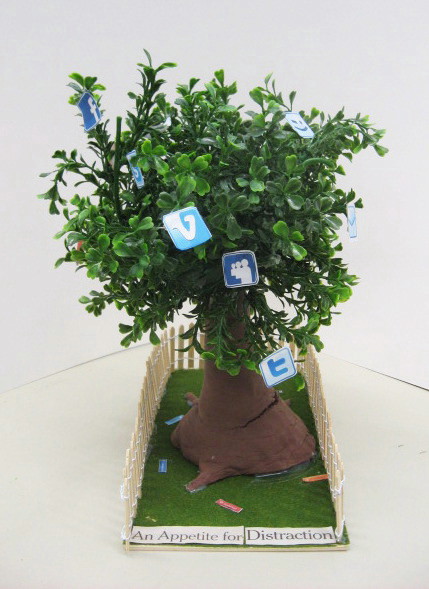
How to make this up- The last new project of the semester got a start today when students randomly selected topics for the 3D final project. From one hat students drew nouns, from the other modifying words or phrases, and together these created concepts, which the students are asked to use as the subject for a three dimensional work. Samples from previous semesters are posted in the previous blog entry from earlier this morning.
Here are some additional student examples:
Homework- The 3D final project started today will be due on December 21, 2018, our last day of class. Like everything else, it must be turned in that day by the end of class time. If you were not here today, you will need to get your subject from me. You may e-mail me and ask me to choose out of the hats for you, or you can choose them yourself next class.
The final version of the museum assignment is due on December 21, 2018, our last day of class.
The semester portfolio, the total of all artwork not otherwise graded this semester, will be graded at our last class meeting on December 21, 2018. Here is what will be expected to be part of that, and the day on this blog that the assignment was done:
Sep 14 contour line (shoes)
Sep 21 negative space (chair, bottles)
Sep 28 value drawing (charcoal)
Oct 5 mosaic collage
Oct 12 color wheel and complement mix
Oct 19 photography
Oct 26 visual rhythm (music)
Nov 2 collagraph plate
Nov 30 two point perspective
For next class Wed 12/12/18- Our next class meeting has been moved by Kean University to Wednesday, December 12, 2018, at the standard time for the class. We will not be starting anything new, so bring whatever materials you need to work on whatever class related item you plan to work on. It can be the final 3D project, something from the semester portfolio, or the museum assignment. On that day I will return whatever student work I have collected so far, including the comic strip projects, printed collagraphs, and completed museum papers.
Materials are whatever you choose to work with to create the sculpture. The piece can be modeled, carved, or assembled from whatever you want to use. Posted student examples (all from today on this blog) will show you some of the things students have used in the past, and if you are not sure, e-mail me and ask questions. Because you have to bring the materials and finished piece to class, I recommend something not too heavy, and a maximum of 12 inches in any direction.
The next week after that, our last meeting of the semester, we will be back on Friday, December 21, 2018.
3D Samples for Intro Class Dec 2018
These are examples of this project completed by students in previous semesters. Today current students will have selected topics for their projects, but this shows how some previous students have dealt with it- their chosen topic and their resulting visualization.
One option is to create a free standing object out of whatever materials you wish to use. Can be modeled, carved, assembled, etc. Can be a single object, make use of a base or platform, etc. You will need to bring the completed piece to class, so I recommend no larger than 12" tall.
Appetite for Distraction
Fallen Merchant
Planet Gone Wild
Troubled Uprising
Another option is to create an enclosed space to contain your view of the concept. The first example here put together two boxes to present a before/after concept. The second example built two shelves and filled them with elements to tell the story.
Impasse Changed
Plowing through the Nation
Friday, November 30, 2018
11/30/18 Introduction to Art
Today's Class- Our topic today was architecture, and my plan was to first have a group critique of the comic strip projects, then a slide overview of the history of architecture, then today's portfolio exercise, a lesson in drawing an interior space in two point perspective. But over the break I was given a deadline to do the course evaluations (a university priority), and quite a few students in both sections didn't finish the comic strips, so I collected those that came in for grading and will do the critique next week, when I hope more will be done. I had requested photos be ready to show today, but as a portfolio exercise, the don't get graded until the final week, so I put off viewing those until next week.
How to make this up- Perspective systems were first developed during the Renaissance as a more orderly and logical way to depict three dimensional objects and spaces, taking advantage of the way all objects diminish in size over space. The result is an image that provides a lot of detailed information to the viewer, even if some parts are distorted. Still the distortion is very regular, so it's easy to understand the original scene. These days most of the work is done on computers, but once upon a time, perspective drawing was a big part of architecture.
Above is a student drawing of an interior of a Vaughn-Eames classroom much like our own, an example of what students did today. Using a full sheet of 18"x 24" paper and a pencil, they chose one corner of our classroom and produced a simplified, yet accurate, line drawing of the major features of that corner. I did a quick demonstration on the chalkboard, had everyone start, and circled the room helping each student advance their drawing. By the end of each class, every student had shown the ability to do a two point perspective drawing.
To do this on your own, choose any interior corner in a building. Your drawing should include the corner, floor and ceiling lines, two items on the wall (door, window, art, etc) and one small piece of furniture. If you don't know how to do this, talk to me in class next week.
Homework- Nothing new today, but if you didn't turn in your 2D final (pastel comic strip) today, get it done as soon as possible. The longer it takes to be finished, the fewer points it will be worth.
Those who haven't yet had me review their museum assignment first draft should get those to me as soon as possible, to give yourself the most time to complete the final version.
I was given a few more collograph plates to print this week and I'll be returning those to the students next week. If you need my help with printing those, you must get them to me by next week.
For next class 12/7/18- We will be starting our final project of the semester, the 3D Final. You won't need he large pad for what we will be doing, unless you want it to protect your comic strip projects for bringing them in or taking them back. You will be randomly choosing topics, so no art materials needed. If you did not turn in your comic strip today, bring it next week.
Friday, November 16, 2018
11/16/18 Introduction to Art
Today's Class- Despite yesterday's unusually early winter storm, Kean was determined to be ready for business this morning. They even plowed a lot of snow, left in a huge pile in the faculty parking lot along Morris Avenue. Our morning class lost the beginning of our day to a fire alarm, but eventually we were allowed back into the building and our classroom.
Luckily, yesterday's weather did not return and our classes were allowed to run as planned. Two main activities today- students continued to work on the 2D Final project (the comic strip) and those who were prepared to do so printed the collagraph plates we made a few weeks ago.
I provided ink and tools to print with, while students brought their plates and provided paper from their pads.
How to make this up- The autobiographical symbolic comic strip project is the same thing we started last week, and all the information can be found in last week's blog post. Finished pieces will be due at the start of class on November 30, 2018, our next meeting. At that time we will have a quick group critique of the works, after which I will collect them for grading.
The collagraph print (cardboard, fabric, etc) is a portfolio exercise involving 3 steps- we made the plates a few weeks ago, they were printed in class today, and students will finish the artworks by collaging materials to the finished print to complete the image in whatever way they want. Let the print dry (we used water soluble ink so they should be dry quickly) then use paper elements to enhance your image. Can be images from other sources (magazines, etc), colored paper, things you've drawn yourself- things that you think would complete the picture. You also have the option of coloring the print directly with watercolors or pastels from your kit, but you must add collaged materials. The print is part of the semester portfolio, due by the end of the semester.
If you didn't have the plate ready today, and don't have the ability or materials to print it yourself, you will have to bring it in to class as soon as possible, give it to me, I'll print it in my studio, and bring it back. After December 7, 2018, there will not be time to do all this, so if you want my help with the 2nd part, get it to me by then.
Homework- The comic strip 2D Final project is due at the beginning of class on November 30, 2018. This is a graded project, so any delays in completing it will result in point deductions.
If you have not yet shown me the first draft of your museum assignment, get it to me as soon as possible. Once I see it, I can let you know what it may be lacking before the final one is to be turned in for grading in late December.
****School closed for Thanksgiving vacation November 22-25, 2018. So recover from overeating, go shopping, sleep late, or whatever you want. No class meeting that week. ****
For next class 11/30/18- Our last portfolio exercise of the semester, drawing in perspective, which relates to the study of architecture. Bring your 18" x 24" pad, pencil and eraser, and some kind of long straightedge (ruler or even yardstick). I will have some, but they will have to be shared, so having your own means you get to complete yours much faster.
Friday, November 9, 2018
11/9/18 Introduction to Art
Today's Class- Today's new topic was narrative, which we determined was stories, which is often the subject of art. In the era when literacy was rare, the main focus of art was to share stories, especially in art financed by the powers in the world (kings, church, etc). I showed a few dozen historical slides, including some examples of the above from the Renaissance to the present, as well as art that made use of a lot of symbols that would have been known to viewers at the time, a lead in to our project.
I also returned the first drafts of the museum assignment turned in last week, reviewing each with the students who wrote them. Those who left early before talking to me can get theirs next week.
How to make this up- Today's project made use of narrative, and is also our first individually graded project of the semester- a symbolic, autobiographical comic strip. The inspiration for this project was Art Spiegelman's MAUS comic strip, originally published through the 80's, and collected into bound form in the 90's. The strip's narrative goes back and forth between the story of the author's father growing up Jewish in Poland, marrying, having some success, then getting sent to a concentration camp by the Nazi forces in power in the 30's and 40's, and also the then current story of his elderly widowed father, whose behavior causes lots of problems for his grown American born son in the 70's. What made the strip unusual is that all the characters are shown as animals, so all Jewish characters are shown as mice, all German people and soldiers are depicted as cats, the American soldiers who liberate the concentration camp are shown as dogs (classic cartoon hierarchy), and other animals play roles in the story as well.
Your assignment is to create a comic strip of your own that tells a true story from your own life, using symbolic characters to portray everyone in the story. Below are some student examples from previous semesters:
Your strip must fill two pages in your 18"x24" pad, at least 12 panels. (those with smaller pads should talk to me about what will be appropriate for them) I recommend sketching things out with pencil first. You may use pens or markers to outline objects and for all lettering (dialog and though balloons, caption, and other comics related lettering). Things that might normally be considered white may stay the color of the paper, but everything else should be in full color, applied with your pastels. Each page of six panels should be on a different sheet of paper. More instructions and another student example can be found on the MAUS link near the top of this section.
Homework- Because this 2D project is time consuming and worth 20% of your grade, next week's class will mostly be devoted to it as well, and you'll be given additional time on your own to work on it, so the final piece will be due on November 30, 2018.
Students who want my feedback/input regarding the final museum assignment should get it to me by December 7, 2018. I will accept them through the last meeting of the semester, but there will be no opportunity to resubmit them for a better grade.
Those who haven't yet turned in the first draft of the museum assignment should do so as soon as possible. Points are deducted on that for each week late.
For next class 11/16/18- We will be continuing the project from this week, so bring your 18"x24" pad, pencil and eraser, and pastels.
While those are being worked on, I'll bring students one at a time over the big table and help you print your completed collagraph plates (cardboard with textures stuck to it), so also bring that plate with you. If not yet completed, do so at least one day before class so the glue has time to dry. We will use paper from your pad, and I'll supply the ink and tools that are needed.
Subscribe to:
Posts (Atom)