Friday, September 14, 2018

9/14/18 Introduction to Art


Today's Class- Today was the first real class of the semester, and we opened with Line, the simplest formal issue we will deal with this semester.  Students were not doing well in coming up with properties and purposes of line, but a short slide show of historical art may have helped.  Then we jumped into some basic drawing exercises, involving various types of contour lines, with shoes as the subject.  I also distributed and reviewed the museum assignment.

How to make this up- Students had a choice of using a shoe that they brought in, or taking one from my bag of old shoes. Using a page from their large pad would be preferable, but with the small size of the drawing, any paper could be pressed into service today.


More student examples, as well as list of all the exercises that will need to be done, can be found here.

This is a portfolio exercise and can be made up for full credit any time before the end of the semester, but I recommend doing it sooner, both as preparation for later drawing exercises and because work will pile up in all your classes through the semester.

Homework- No art homework.  The museum and research assignment was distributed today and the first draft is due on November 2, 2018.  

For next class 9/21/18- More basic drawing involving line, with a focus on negative spaces.  Bring your 18" x 24" pad, pencil(s) and an eraser.  I'll provide the subject matter, which will not involve any shoes.

Friday, September 7, 2018

9/7/18 Introduction to Art


Today's class- Today was our first meeting of the semester.  The syllabus was distributed and reviewed. Students filled out a survey regarding their past art experiences, which we shared as a group, and I shared my experiences using the same format.  

How to make this up- If you missed today, make sure to request a syllabus at next week's class.  

Homework- Nothing yet.  If you are on campus over the next week I recommend visiting Tino Cook's exhibition "Caged Bird" in the student gallery on the first floor of Vaughn-Eames.  Hours are listed as noon to 8 pm daily, with a special reception on 9/12/18 starting at 7 pm.  Not required, and there is no related assignment, just something free and worth seeing if you are in the building.

For next class 9/14/18- We start our study of line.  Bring your 18"x24" pad, pencil(s) and an eraser.  We will be drawing shoes, and I'll have some for the class to use.  You are welcome to provide one of your own, a closed shoe (no sandals or flip flops), any style, or even take one off your own foot if you like.  The semester museum assignment will be distributed as well.

Thursday, September 6, 2018

Welcome to the Fall 2018 Semester


This is the blog website that I have set up for the fall 2018 semester.  I have two sections of FA 1000 Introduction to Art on Fridays.  Each week I will post information about the classes we have had.  Each post will have a title that includes the name of the class and the date.  Posts about the class will have text in red.  Posts about school information not related to the class will appear in black.

Each week there will be a brief description of the work done that day, photos of student examples of the projects (when available), instructions for the class, special due dates when they exist (everything is due by the end of the semester).  I will list the materials required for the following week in class, reminders about written assignments, and museum links are posted.

This online blog is not a substitute for coming to class.  It is to provide information to registered students who might miss a class so that they can keep caught up and do so quickly.  Even if you never miss a class, you may find it useful as a reminder of what we have done, a place to check for required materials, to verify deadlines on papers or projects, or to see past student examples.  It is available 24/7 and will provide answers to the most common questions that students have, without a need to wait for a reply.  If you have class related questions that aren't answered by the information here, you are welcome to send me an e-mail and I will try to answer it as quickly as possible, usually within 24 hours.

Friday, May 18, 2018

5/18/18 Intro to Art


Update-

All grades were submitted to KeanWise before the Wednesday deadline, and I received acknowledgement from the university of receiving them.  So I am assuming that they have them.

Enjoy the summer.

Friday, May 11, 2018

5/11/18 Intro to Art


Today's Class- Today was our last meeting of the semester, and everyone still on the roster showed up for the occasion.  Each class presented their 3D projects, and as expected, many were quite creative with their ideas.  I returned lots of comic strip projects and printed collagraphs and old papers, graded the 3D works, the semester portfolios, quite a marathon.  My Kean e-mail box received 9 student papers (all during class time, so before the deadline) and I got a few more hard copies handed to me in class.  

Things received today will be graded in the next few days- they have to be since final grades are due to Kean in just a few days.


How to make this up- Nothing to make up- if I haven't got it or seen it by now, it's too late.


Homework- As with above, if it wasn't turned in by the end of your class meeting, it ain't happening now.


For next week- I guess you can sleep late; I certainly won't be getting up at 5:30 am as I have been on Fridays this semester.  

I will grade the materials received today and calculate the final class grades in a few days, then submit them to KeanWise.  I'll post something here to verify that.  How long it  takes KeanWise to release them to the students I have no idea.

Friday, May 4, 2018

5/4/18 Intro to Art


Today's Class- Nothing new today- I figure you guys already have enough things to do before the semester ends next week.  So in general it was a work day, with students free to work on anything related to the class.  I used the day to return a lot of student work I had collected and graded, such as the comic strips, museum and research papers, and collagraph prints, as well as collecting some from students who were late turning them in.  For those who asked I provided a list of the expected items for next week's portfolio grading, but I'll be posting that here as well.

How to make this up- By now you should all know what you need to do for the rest of the semester.  If you are not sure, this blog shows everything we did and you can compare it to that which you have done.  I took in several comic strip projects from students today.  Here are a few that went back today:


Homework- The one thing that is definitely due next week is the 3D final project, based on a theme randomly chosen.  If you still haven't received one, you should contact me soon so I can find one for you.  Several students still owe me papers (first time or revised ones).  Some still owe me comic strip projects, and today some were working on portfolio exercises that they had missed the first time or had not finished in class.  


For next class, 5/11/18-  Our last meeting of the semester.  It's a grading day.  Bring the completed 3D project, any back projects or papers that haven't been graded yet, and the semester portfolio.  Here is a list of what is expected as part of the portfolio, and where on this blog you can find the information if you need it:

1/26/18-  Contour lines (shoes)
2/2/18-  Negative space (chair)
2/2/18-  Negative/Postive space (bottles)
2/9/18-  Value (charcoal)
2/16/18-  Collage/mosiac
2/23/18-  Color theory (wheel)
2/23/18-  Color theory (compliment mix)
3/2/18-  Photography
3/9/18-  Rhythm as visual element
3/23/18-  Printmaking and texture

Next week I'll be grading the portfolios (checked and returned the same day) the 3D projects (presented to class, then graded and returned), any late arriving comic strips or papers (students can leave them with me or wait until I get them graded that same day).  The sooner you get there, the sooner we will finish.  This will be our last meeting of the semester, so any work not turned in by the official end of the class meeting will not be accepted after that.

Friday, April 27, 2018

4/27/18 Intro to Art

Today's Class-  A very busy day today, so luckily my tires were all in better shape.  We started with a brief in class critique of all the comic strip projects that were due today.  Then we moved on to the final 3D project of the semester, found object sculptures based on randomly selected themes. Then we took time to complete the course survey forms, after which we could devote time to thinking about approaches to the last project.  Along the way, I collected research assignments due today, collagraph plates from those students who did not have them ready to print in class, and the comic strips to be graded before next week.

How to make this up- The last project this semester is a 3D sculpture made from found objects and other materials, representing the themes chosen from hats in class.  You may use any material you wish to depict your chosen theme.  I showed slides of some examples from the past century, sculptures made not from traditional techniques like carving stone or casting bronze, but rather from assembling, and materials can be anything you can find.  Below are some student examples from previous semesters, along with the random phrase that inspired each:


appetite for distraction


fallen merchant


impasse changed


planet gone wild


plowing through the nation


troubled uprising


The piece can be a freestanding object, or permanently attached to a base.  You may also create a backdrop or location, as in a few examples above, or some that we saw in  class today.  It should be at least 8" in one dimension, but no bigger than what you can easily carry to class. If you weren't in class today to get a topic, either e-mail me during the week or you can get one in class next week. 

Homework- This final 3D project is due by the end of class at our last meeting- May 11, 2018.

If you still owe your comic strip project or any papers, get them to me as soon as possible.  The longer the delay on any individually graded project, the fewer points it will be worth.  

Everything not individually graded will be part of the semester portfolio and will be graded the last day of class.  I will eventually produce a list of what's expected, but you can use this blog to review this entire semester and verify what you need.

For next class 5/4/18- A general work day for anything part of this class.  If you are all caught up on everything else, you may take advantage of the tables and space to work on your 3D final.  Or if you need to, you can work on one of the individually graded projects, a portfolio exercise, or even one of the papers.  Bring whatever materials you need to work on what you plan to do.  


Friday, April 20, 2018

4/20/18 Intro to Art final edition


Today's Class- Due to circumstances beyond my control, I was not able to make it up to Union today.  The day started out normal enough, up at 5:30 am, out to my car by 7:30 am, which would allow me to get to Kean in time to check e-mails, pull slides, etc.  However, my car was pitched to one side in its parking space, and that's never good. When I got close enough, I could see that one tire was completely flat.  Didn't get a photo of it, but imagine a hubcap resting on a pile of black banana peels.  No photo because I used the time waiting for tire assistance to clear a bunch of stuff out of my car- things for today's class, things for my local woodcut class, snow shovels and other winter tools that I just can't give up yet (we may get below freezing tonight), etc.  Got done just in time to uncover the well that holds my spare and send e-mails to the morning class.  Changing it didn't take long, but those donuts are not meant for high speed or long trips, so my usual 100 mile round trip on the GSP was out.  
That one screw between the treads doesn't look like much, but with the weight of my car on it, a disaster.  Called the office, sent e-mails to my afternoon students, then set out to get some replacement tires.  See, much better.


How to make this up- Had a lot of time to think about this, and came up with a new plan.  I've decided to abandon the earlier idea of having us do today's lesson (architecture/perspective drawing) next week, and instead we'll just use the remaining 3 weeks to work on the 3D Final project.

Homework- Nothing new, but some dates may have changed.  For example, the 2D Final (symbolic autobiographical comic strip in pastel) will now be due at the beginning of our next meeting- April 27, 2018.

The second written assignment, the research paper, will still be due on April 27, 2018.  This is to allow students who turn it in on time the opportunity to correct the mistakes and resubmit it for a higher grade.  Turn it in late, you get what you get.

Those who have not yet printed their collograph plate should bring the cardboard plate to class next week.  I'll collect them, bring them to my studio, print them there, and then bring back the plates and prints the following week.


For next class 4/27/18- We will start with a quick class critique of the comic strips, which I will collect, grade, and return the following week.  And if the course evaluation forms are in my mailbox, we'll need to fill those out.

After that, we will start work on the 3D Final.  The subject of your sculpture will be determined by a random drawing thing.  You don't need your 18"x24" pad, unless you want to use it to protect your comic strip.  I do recommend something to write with and a notebook or loose paper to start working out ideas for your last piece.  Materials for that will be discussed in class next week.


Friday, April 13, 2018

4/13/18 Intro to Art


Today's Class- Today was the continuation of some things begun in previous classes.  Most students worked on the symbolic/autobiographical comic strip, our first individually graded project of the semester.  Those who brought in completed collagraph plates got them printed up.  I answered a lot of questions about papers, old and forthcoming, and we looked at a few photo examples from students who had brought them in.


How to make this up- All the information about the comic strip  project and some student examples can be found on last week's blog post (April 6, 2018 on this site).  Below is a student example print from a previous semester.


Printed with black water soluble relief ink on white paper from the big pads.  

Homework- The symbolic autobiographical comic strip project is due at the beginning of class on April 20, 2018.  This is an individually graded project, so late arriving projects will be downgraded as usual.  

The printed collagraphs are part of the semester portfolio, so must be completed by the last day of class.  If you have the tools, materials, and know how to do it on your own, all well and good.  If you would prefer me to do it for you, bring in your completed cardboard plate as soon as possible.  I'll collect them, bring them to my studio, and print them there.  I'm not going to bring in the ink and tools every week to do it there.  

The historical research paper is due at the beginning of class on April 27, 2018.  


For next class 4/20/18- We will do the last portfolio exercise of the semester, an architectural drawing using two point perspective.  Bring your 18"x 24" pad, pencil and eraser, and some kind of straight edge is recommended.  I'll have several yardsticks, so if you don't have your own ruler, you'll have to share with everyone else.

Friday, April 6, 2018

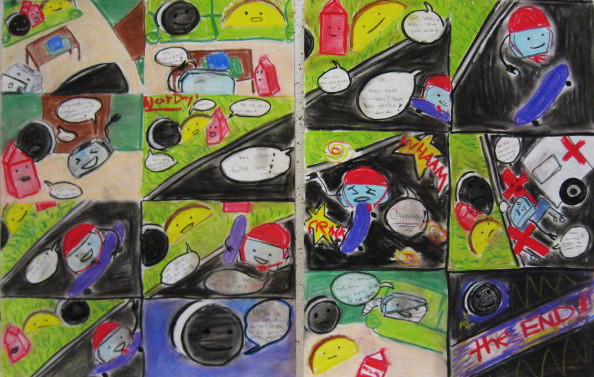
Student examples of 2D Final- autobiographical symbolic story


Today's Class- Our topic today was narrative, which we determined was the quality of telling a story.  

The inspiration for this project is the comic strip Maus, published in the 1980's and early 1990's, and collected in bound volumes in the 1990's, what is often called a graphic novel.  It simultaneously tells two stories, one of the events in the life of two Jewish people in Poland, captured in the Holocaust, and imprisoned in a work camp.  The two prisoners do survive, the camp is liberated as  World War II ends, they emigrate to America, and have a child.  The second story takes place much later, from the point of view of that child, now a grown man living in NYC, and having to deal with his often cantankerous elderly widowed father.  What made it unusual was that the characters are all portrayed as animals, in a cartoon hierarchy.  The Jewish characters, or all nations, are shown as mice, who are constantly pursued by German soldiers (cats), until they are defeated by the American soldiers (dogs). Other animals play roles as well.  Sometimes the animals are drawn as cartoon characters- personified with human style arms and legs, and with expressive faces.  Sometimes the characters are shown as humans wearing animal masks, Halloween style.  


What our project will have in common with this is that students will be creating a comic strip that tells a true story from their lives, so it will be autobiographical, and portraying themselves and other characters with symbols instead of people, so it will be symbolic.  The symbolic characters can relate to the nature of the story, or be personal symbols the student associates with the people. The story can be serious or inconsequential, happy or sad- it doesn't matter.  Here are a few examples from previous semesters:

These first four are one I have in my possession, and if we were meeting you could see them in person.  These are all  examples of this strip done by students taking this class, the same problem.  In this one, the characters all all beach related- a ball, pail, umbrella, etc. These were chosen as a personal symbol, of interest to the participants, or based on characteristics possessed by the participants, according to the creator. The story has nothing to do with the beach, but the characters all liked the beach.  The story is actually about a time the group was playing field hockey and an injury occurred. In the first page, the group gets together to play the game, but early in the second page, the ball gets injured, has to go to the hospital, is seen by a doctor (a shell) and eventually emerges on crutches. (in the class, the student no longer needed them, so a happy ending. 


The second strip also has a beach theme, but this time the story is also a beach story, so the symbols are related to the story.  Two friends decide to go to the beach, the two friends are depicted as bathing suits with no further personification. The two bathing suits take a trip to the shore, lay on the beach, enjoy some pizza, then more time on the beach.  A nice day.


Our third example has no beach at all, but three Kean friends who decide to go see a view of the George Washington Bridge.  The symbols are a flower, a water drop, and an apple, none of which have anything to do with the subject, so these are personal symbols chosen by the creator. They depart together by car, later walk through the woods where they have a scary encounter with a spider, eventually reach their goal and see the bridge, the spider incident not so bad.


Our fourth example is a less good one, what not to do. The story isn't bad, about a student getting a job to earn some money.  He portrays himself as a 50 lb. dumbbell type weight, which may be a personal symbol, but in this case it is a story symbol as well. The job is working in a weight room.  Our character gets the job, helps spot lifters, cleans, organizes, and at the end of the first page, gets a paycheck.  The second page shows him going to the bank to turn it into cash, which he takes to the store, and uses to buy some nice sneakers. The story is good, the character/symbol is good, but the art is lacking. The drawing is perfectly fine, but there isn't enough color- too much empty white space.  The grade ended up being a B, but would have been a A with more color.


Here are several more good examples of this project from past years.


Each strip should use two full pages from your 18" x 24" pad, with 6 more panels per page- panel size can vary as needed.  Format can be horizontal or vertical.  I suggest using pencil to sketch out the layouts.  You may use pencil, pen, or markers to put in lettering (as in dialogue balloons, boxes of captions) or outline objects, but all color must come from pastels.  You can also go wordless if you want. New colors can be created by combinations (like we did with the paints), typically layering one over the other and blending, such as with fingers, a scrap of paper towel, or anything else you prefer.  Objects that one might expect to be white may remain that way (pastels or white from the paper), but otherwise use color everywhere, like what you might see in a Sunday paper. 

Other rules:

1) Story should be true, something that happened in your life. You will be a character in the story.

2) Story can take place in any time, and can cover as long a period as you want- a moment, a few days, a year, a lifetime.

3) Characters must be symbols, not just humans.  You have the options of adding limbs, faces, and other human attributes, but you don't have to.  There are examples of both styles above.

4) If it makes sense for the characters to change (age, etc), that is permitted, but make sure it is clear that the character is still the same. 


5) We can do anything permitted in comic strips.  Words can be used in transitions or to show sound effects.  The above examples can provide guidance.  Dialog balloons, thought balloons, all available. 

Friday, March 23, 2018

3/23/18 Intro to Art


Today's Class-  Today's topic was printmaking, the artistic mediums that include a fixed matrix that is used to create identical copies of an image, which can allow the cost per piece to be less.  Processes can include relief (woodcut. linoleum), metal plates (etching, engraving), lithography (stone), silkscreen, etc.  We used slides to get an overview of such artworks.  
Our portfolio exercise today involved a more modern print process, the collagraph, which encompasses a number of materials collaged to a flat surface, with ink applied in a variety of ways, and different possibilities for printing.  I chose a process that is simple and inexpensive- plates made from thin cardboard, and found object scraps attached with white glue.  Printing will come in a few weeks.


How to make this up- If you attended class today you may have what you need, although the option exists to add more to your plate before we print them.  If you missed today, you have to do it all on your own.  Here are some student examples from previous semesters.


Each of these sets shows the plate that was used to print the image, and the resulting image. The ink is water soluble black relief ink, applied with a roller.  Note that the printed image is a mirror image of the original, so if you want your print to include letters or numbers, you'll have to make them backwards on the plate to print forwards on the paper.  Also note that the ink is black and that the color of the materials in the plate have nothing to do with the color on the print- it will all print black.  Students do have the option of adding color to the finished print as in the bottom example above- once the ink is dry, color can be added over the top by watercolor, thin pastels, colored pencils, etc, without eliminating the texture in the original print.

Start with a piece of thin cardboard, the large panel of a cereal or cracker box will do fine.  Create some kind of recognizable image out of scrap materials and glue it to the cardboard surface.  In class I provided a lot of different kinds of cloth, but I showed examples including such things as yarn, leaves, candy wrappers, paper towels- a thin coating of diluted white glue will keep them more stable.  The one rule I have is that 8 different textures must be in the final print, and the above examples show how different materials can print different textures.  I do advise not using cotton balls- they seem like they would have interesting results, but the ink doesn't stick to the cotton, but the cotton sticks to the ink, makes a big mess.

Homework- If you didn't complete your plate in class, get it finished by April 13th, 3 weeks from today.  On that day I will bring in the ink and tools to print them in class.

The majority of students in both classes turned in the museum assignment yesterday.  Those will be returned graded at our next meeting.  If you didn't do it yet, I will accept them late, but point deduction will increase with each week you miss.

The other written assignment, your research paper, is due April 27, 2018.  

***Kean is closed on March 30, 2018***
   **********No class that day***********

For next class April 6, 2018- We will start the first individually graded art project of the semester, which will involve two weeks in class and you'll get another week to finish it on your own.  Bring your 18"x24" drawing pad, pencil and eraser, and your pastels.


Friday, March 9, 2018

3/9/18 Intro to Art


Today's Class- The topic today was rhythm, which we usually associate with music, but there is a visual equivalent that can be found in art.  I showed a few dozen art historical slides, paying attention to times that artists used visual rhythms in their pieces.  Then we did a portfolio exercise that involved watercolor paintings that were influenced by types of music playing while the were painted.

How to make this up- You will need your 18" x 24" pad, watercolors, brushes, and a water container.  Palette is optional, but you can use your colors as they are manufactured and don't need to mix them.  However, you can use the paint any way you want.  You will play different types of music, 15 minute segments, and do abstract paintings in reaction to the music you are hearing.  Below are some student examples from previous semesters.


More student examples and information about the music that was used (or how to substitute) can be found here.

This is a portfolio exercise and can be made up any time before the end of the semester for full credit.


Homework- The first written assignment, the museum paper, is due at the beginning of class on March 23, 2018.  

*****Spring Break 3/12/18 - 3/18/18*****
******No class meeting next week*******

For next class 3/23/18- We will start a multi-week project related to printmaking, a collograph print.  This involve making a printing plate by attaching items of various textures to a flat surface, rolling it with relief ink, then printing it.  Here is an example of student plate and print from a previous semester.

I will provide the cardboard to make the plate, and a variety of materials that can be used to collage your image.  You need to bring scissors and glue (white glue is best) and are welcome to bring additional material to glue to the plate.  (materials should be relatively thin, have some kind of texture)  The glue needs time to dry and these will be printed another week, so you can leave your big pads at home that day.


Friday, March 2, 2018

3/2/18 Intro to Art


Today's Class- Today's topic was photography, a relatively recently created artistic medium with long ago roots.  It begins with the camera obscura, a tool known around the world to many ancient peoples, but well developed in the baroque period.  In the 19th century, modern chemistry knowledge allowed people to preserve the projected images in a more permanent form, thus inventing photography.  I showed a few dozen slides of photo based work, ranging from the earliest experiments to the contemporary, covering the evolving technology and the many uses it is put to in art. For many people film has been replaced by digital technology, but the art part is pretty much the same. 

I distributed a take home assignment, and we took a tour of Vaughn-Eames, checking out any studios and galleries that were open and seeing what kind of stuff goes on in an art building.

How to make this up- I gave out a handout with a list of 20 photos to be taken, on your own time.  This is a portfolio exercise, but the plan is to share the results with the whole class.


For more details on the assignment, as well as student examples of each part, click here.

Homework- The photo assignment is a portfolio exercise, but I'd like to see them all by April 13, 2018, so we can share the results with the whole class.  They can be printed on any kind of paper, and don't need to be mounted, but just label them so we can easily see which part of the assignment they are for.

The museum assignment is due on March 23, 2018.


This afternoon, Kean University announced they were cancelling all remaining classes today because of the weather.  They waited until after we were done to announce this.  I've had worse rides home from school, and I hope you all got home safely.  Weather predictions for next week are better.

For next class 3/9/18- We go back to color, this time more expressive than the theoretical stuff we dealt with last time.  Bring your 18" x 24" pad, watercolors, brushes, and a water container.  You may use all the colors as they are in the kits, but if you think you may want to mix colors, be sure to have a palette.  

Friday, February 23, 2018

2/23/18 Intro to Art


Today's Class- Although we dealt with a few aspects of it last week, today we began color for real, exercises related to color theory.  I talked about the scientific nature of color, sources of color for art purposes, and then showed a few dozen slides related to the history of color in art, both painting and sculpture.  Then on to the exercises.  We used watercolor to make a 12 hue color wheel, and do an exercise in complementary color mixing.


How to make this up- Below is an example of the kind of thing we did today.  Everyone completed a color wheel, using primary, secondary, and intermediate colors.  The second part was selecting a pair of complementary colors and an exercise that involved mixes and tints of those colors.


Detailed instructions and another student example can be found here.

Homework- No new homework.  However, we are about to enter March, so keep in mind the museum assignment will be due in a few weeks.

For next class 3/2/18-  Next week's topic is photography, and we'll be looking at many examples of the history and uses of photography over the past few centuries.  The exercise will be something you take home to work on, so you don't need any art materials for next week's class.  I will distribute the assignment in class next week.  I will use a chunk of the remaining time to take us on a tour of the building, as many of the studio classrooms as are open, and perhaps the student show in the gallery downstairs as well.

Friday, February 16, 2018

2/16/18 Intro to Art


Today's Class- Today's topic was monumental art, which I define as large scale art that is permanently part of a building or public space.  I showed a few dozen slide examples, starting with cave painting, then moving through Etruscan, Roman, Byzantine, Gothic, and the Renaissance, and such mediums as paint, fresco, mosaic, and stained glass.  Today's art project was a variation on the idea of mosaic, a collage using small pieces of colored paper to build an image.

How to make this up-  You will need to select a color photograph of a 3 dimensional object or scene.  What it is doesn't matter.  You will do a basic pencil line contour sketch of the image, including all background items.  The drawing will either be 6" x 6" or 4"x 9" (vertical or horizontal) so make a box like that in pencil.  In reproducing the original photo, you may crop it, draw it at 100% scale or enlarge a small area, but everything that would fit into your box must be included.  Then use colored paper from magazines to match the colors in your original photograph.  The color pieces should be no larger than 1/2" square, but may be smaller.  Pieces of paper may overlap, or have a small white space between them.  Some student examples from previous semesters can be seen below, both original photo and student mosaic-


 This is a portfolio exercise and must be completed by the end of the semester for full credit.  

Homework- Nothing new, but keep in mind that you have two papers to work on, the first of which is due in late March.

For next class 2/23/18- We continue our study of color, this time with some basic color theory.  Bring your 18"x 24" pad, pencil and eraser, watercolor paints, watercolor brushes, mixing palette, and a container to hold water.

Friday, February 9, 2018

2/9/18 Intro to Art


Today's Class- Today's topic was the formal issue of value, use of relative tones of dark and light in art.  This can serve many purposes- description of areas, implying three dimensional form, creating space, focusing attention, establishing time of day, etc.  I showed about 2 dozen slides of historical art, pointing out the ways light and shadow were used by the artists, then we got on with the portfolio exercise of the day- a value drawing using charcoal.

How to make this up- I set up a simple still life in the center of the darkened classroom, with an overhead spotlight shining on it.  The still life consisted on a stool with a white bed sheet draped over it, and on and around that several simple objects, all painted white, so that local color values would not be a factor.  Today it was just about light and shadow.  Below are a few examples of typical student charcoal drawings from previous semesters.


To do this on your own, put a box on a low table, drape it with a white or light colored cloth, and place three white or light colored objects on or around the box so all can be seen.  Use a single light source to created patterns of light and shadow.  Draw the still life on a sheet of your 18" x 24" paper, including  all three objects, and any of the white fabric seen in your view.  Try to match the shapes of your objects and the light and dark shapes as closely as possible, not forgetting what we learned about negative space.  Spend up to 90 minutes on it.

Homework- Nothing new, but keep in mind that the museum assignment is due March 23, 2018.  Plan accordingly.


For next class 2/16/18- The topic will be monumental art, which I am defining as large scale art that is permanently part of the location.  A common medium that goes back to antiquity is a mosaic, a two dimensional image made up of small bits of stone, glass, ceramic and other bits, arranged to form some kind of image.  We will be doing the same thing, but using paper to make the images.  You will choose a color photograph from a magazine, sketch the basic shapes with a pencil, then use small cut up pieces of paper from other magazines to reproduce shapes and colors from the original image.  Everything will be glued to a page in you big pad.  Below is a student example, with the original image on top, and the collage version below.


Bring your 18"x 24" pad, pencil and eraser, scissors, and a glue suitable for gluing paper to paper.  I will bring a pile of old magazines, but if you have some you don't mind cutting up and want to contribute them to the pile, feel free to do so.