skip to main |
skip to sidebar
Today's Class- Today we began our Stone Age art project. As I've said before, I would have preferred to do this earlier in the semester and have it lead into other design projects. but the winter just wasn't going to let that happen. I opened with several slides of art from the cave dwelling era, ten to forty thousand years ago, pointing out that the primitive technology encouraged the art to be chosen based on the material being used- such as the dimensions of a particular reindeer antler, mammoth tusk, or animal bone. I started by having everyone take several shells collected from the beach and seeing what kind of shapes were suggested, kind of like with the coffee trays. Then I had everyone start working on the project, creating a sculpture from all natural materials that would depict a human or animal.


How to make this up- You will be making a three dimensional object that depicts a human or animal form, by far the most common subjects in that era. It may be something real, or mythological. It may be the complete subject or just a significant portion of it (like a head, for example). It should be at least 6 inches in one dimension, though it may be larger. Except for glue, you may only use any material that would have been available to a stone age artist. This includes natural wood (sticks, chunks of tree, solid planks, but not plywood), rocks, shells, seeds, bones (make sure they are cleaned of all other tissue), leaves, flowers, seeds, and similar items. Keep in mind that living plants will eventually wither and die, so if you are planning to use those materials, you may want to wait until close to the due date to attach them. Materials can be used as found, or can be carved or broken up as needed for your sculpture. You may use paint to decorate or color the item, as this was a common aspect of cave art. Above and below are student examples from previous semesters.
This graded natural materials assemblage project is due at the beginning of class on April 14, 2015.
Homework- Although the pair of figures we worked on last week is in itself a portfolio exercise, the one based on the actual proportions of the figure is part of next week's project. If you don't have it done by the start of class, you'll have to work on it first before you do the rest.
Those who have not yet turned in the cast off items (plastics) assemblage piece or the foam core relief panels (skeleton and related image) can still do so for partial credit. The longer they are late, the fewer points they will be worth in your final grade.
For next class 4/7/15- We will be constructing something related to the figures we made last week and the idea of proportions. Bring the original figure, a new piece of foam core, x-acto knife, glue, pencil and eraser. A ruler is recommended as well.
Today's Class- We opened by looking at the plastics and other cast off manufactured materials based projects that were due, which were all graded and returned by the end of the day. Then we got started on something new.
Today the focus was on the concept of a canon of proportions, a standard of accepted proportions for portraying the human figure in both two and three dimensional art. They can be rigid rules for a whole society, like the Ancient Egyptian 1 body height = 18 fists rule, or proportions favored by individual artists, as in body to head size ratios in Classical Greek art. We also discussed the post-Renaissance Mannerist period, and how more extreme proportions are often favored in comic books and contemporary advertising (see above). Then the class started a portfolio exercise that will lead into a graded project in a few weeks.
How to make this up- Select a photo of a human. Can be male or female, any pose, as long as head to toe are all visible. I had the class pull them from a pile of magazines on a shelf, but any source is acceptable.
Reproduce your chosen figure as a 3 dimensional object using foam core and/or bristol board. Match the pose and body proportions within reason. It may be glued to a base to help it maintain the pose from the photo. After that, you will need to make a second figure with the same materials, but varying the body proportions in specific ways. For the second figure keep the head, torso, upper arms, thighs, and feet the same size, but change these other parts accordingly:
neck twice as long
shoulders twice as wide
waist/hips half as wide across
forearms, lower legs three times as long
The longer limbs may require changing the pose so that things can fit the space, but otherwise try to keep them as much the same as possible. Above and below are student examples from today and previous semesters. In each case, the smaller figure is the one based on the original photo.
These two figures are a portfolio exercise and must be completed by the end of the semester to receive full credit. However, the first figure, the one based on the proportions in your original photo, will be part of a graded project you'll be beginning in two weeks, so you should get that one done by then.
Homework- No new graded projects, but those who still haven't turned in back projects should get them done as soon as possible. After next week, I will not be accepting the Make 100 Module projects, and some still owe the foam core relief projects, and the plastics/garbage based graded projects.
The Museum papers are due on April 28, 2015, though they will be accepted as late (with a grade reduction) through the end of the semester.
For next class 3/31/15- We will begin a new graded project involving the use of natural materials. Students will be required to use only materials gathered directly from nature to create a sculpture based on an animal or person. I'll be giving more details next week, as well as providing some materials, but here are some examples from previous semesters to give everyone an idea of what kinds of materials will be acceptable for this project:
Bring a sketchbook and pencil, glue (hot glue will be best), and whatever assortment of wood, rocks, shells, seeds, etc you can gather now that the snow is mostly melted. You will also have two weeks beyond the next meeting to complete the project, giving you time to gather additional materials to help you finish whatever you are inspired to start next week.
Today's Class- We opened with a critique of the foam core relief sculpture panels project, which combined a skeletal image and one the student made up. After that I showed a few slides that emphasized suggested shapes and concave and convex surfaces. That was followed with a portfolio exercise using pulp cardboard coffee trays as raw material for sculpture. Those sculptures were looked at toward the end of class, along with a visit to the Howe Gallery to see the current student art show. The relief panels were returned graded at the end of the day.
How to make this up- Acquire two or three pulp cardboard coffee trays, usually available wherever cups of coffee are sold. These humble objects include an interesting combination of molded shapes, curves, and transitions between them. Spend a few moments looking at both top and bottom sides, noting the kinds of shapes that are involved.
When you are ready, use scissors or x-acto knife to cut the trays into pieces, and glue them together to make a sculpture. There is no specific assignment today, so you may make something representational or go for a pure abstract design. Try to make use of both inner and outer surfaces. Above and below are examples from today and last year. Additional student examples, and more specific instructions can be found here.
This is a portfolio exercise and must be completed by the end of the semester to receive full credit. Graded projects will become more time consuming as the semester progresses, so I recommend not waiting to long to make up any of the exercises.
Homework- The graded project involving using cast off found objects (plastic, garbage, etc) is due a the beginning of class on March 24, 2015.
****spring break from March 16th to March 20th****
****no class next week****
For next class 3/24/15- We will begin a new graded project relating to proportions of the human figure. Bring some foam core and some bristol board, along with pencil and eraser, scissors or knife, and glue.
Today's Class- Thanks to the never ending winter, the schedule for the semester was rearranged to postpone the natural objects project to a time when we hope that enough snow has melted to allow us to find natural objects. Instead, we started a graded project involving cast off manufactured items (garbage, essentially). I had posted online examples from an artist I know, along with student examples from previous semesters. I had instructed students last week to search for interesting and workable materials to bring in, and brought in a bunch of discarded household plastic for people to make use of. Some came in with a plan, some were inspired in the classroom. The class had the day to work on it, and will be able to acquire more garbage and finish it at home.


How to make this up- You can either come up with an idea and start looking for materials, or gather a bunch of discarded plastic and other manufactured stuff and see if it gives you an idea. Above and below are student examples from previous semesters, so you can see some of the materials used.
Your finished piece must be at least 12" in at least one dimension, and all visible surfaces must be made from repurposed manufactured items. Your sculpture must be based on a recognizable three dimensional item or scene, with all shapes, textures, and colors coming from the items you used. The materials may be broken or cut up, but no paint is allowed. Depending on what you are working with, hot glue or white glue may be used to assemble it. A base is not required, but may be desirable for certain things.
Homework- Your completed graded discarded plastics sculpture is due at the beginning of class on March 24, 2015. (thanks to spring break week, you get three weeks instead of two)
For next class 3/10/15- We will do a portfolio exercise in adapting complex shapes. For material you will be using pulp cardboard coffee trays, distributed in places where people buy cups of coffee. Have at least two, but three will be better. You will also need scissors or a knife to cut them up, and some kind of glue to assemble it.
Today's Class- Today the focus was on planes, broad areas that make up the exterior of a sculpture. I showed a few dozen slides of art (a lot of the industrial steel sculpture of Richard Serra) and discussed how materials can be manipulated for different effects. Then the class started on today's portfolio exercise, building a small model of an automobile of their choosing, then using an identical set of car parts to design and build an abstract sculpture. We also looked at some late arriving 100 Module pieces and talked about next week's revised schedule.

How to make this up- Students were asked to pick a favorite car from a purely design point of view. Using photos of the car, the assignment was to create a small model of the car, using the same rough proportions, paying attention to the broad exterior surfaces and major curves of the body, using a mix of foam core and bristol board to make the pieces. Meanwhile an identical set of car pieces was created and set aside. After completing the car, each student was asked to assemble the second set into some kind of abstract sculpture, looking like anything but a car. Above and below are two examples from today's class. The full detailed instructions and more examples from previous semesters can be found here.
This is a portfolio exercise and must be finished by the last day of class in order to receive full credit.
Homework- The foam core relief sculpture project begun in class last week will now be due at the beginning of class on March 10, 2015.
For next class 3/3/15- The original plan for next week was to start a project involving using materials from nature, but right now most of nature is under 3 feet of snow and ice, and that seems unlikely to disappear any time soon. So we are switching the order of things a little and going with a project involving only manufactured discarded materials.
Shown here are several examples of the work of Jersey Shore artist Lisa Bagwell. Her art is made from discarded materials she finds or is given from friends who know her interests. Above and below are images of a "giant hoagie", which has bread made from corks, and filling that includes plastic lids, gloves, sponges, fabric scraps, and disposable plastic razors. The olive on top is some plastic bottle caps.
The three pieces above include a bird made largely from information tabs commonly found in starter plants, a shell made from plastic mouthpieces from small cigars, and an ice cream cone made from popsicle sticks, bottle caps, and a plastic spout. The large bird below in the cork tree is made from some of the same materials.
The bird below is largely pencils and plastic utensils.
For this project you will need to create a piece of your own using only discarded manufactured items. It should be a recognizable object or living thing, and at least 12 inches in one dimension. Color and texture will come from the found objects that you use. You may assemble it by any means you wish, but hot glue will probably be the easiest. You can show up with a plan and materials to make it, or just bring a bunch of junk and get inspired in the classroom. Bring a hot glue gun (or at least hot glue sticks to use in one from the cabinet), sketchbook and pencil, and any disposable plastic or metal junk you can find.
Today's Class- Despite the weather complications, we had more than half the class in attendance. We started with a critique of the Make 100 Module projects. Although each was made with just one simple repeated shape, the combinations evolved into interesting patterns and structures, and the final pieces ranged from very orderly and organized structures to chaotic abstraction, all of them interesting in their own way. Below is a city made of some of these sculptures.
After that we began on the next graded project, involving the idea of relief sculpture. Relief sculptures are where 2D and 3D meet, generally things carved into a relatively flat piece of material, such as wood or stone. The image is just on the one side and is best seen from that side, so it offers fewer views than most sculpture. We started a graded project making reliefs from cut foam core.
How to make this up- I distributed drawings and diagrams of skeletons, both human and animal. Skeletons are nature's great structures, a framework that supports a body, provides the means to move, and protects all the vital organs. There are a mix of positive and negative shapes, all with interesting organic shapes.
Start with an image of a skeleton, human or animal. I'll have some in class, or you can find your own if you don't like my options. I used the student drawing above as inspiration for the foam core skeleton below.
Choose a portion of it to reproduce as a relief image using foam core. Crop it so that the portion you are reproducing fills the 12" square composition. You can cut the whole skeleton from a single piece of foam core, or cut it out as series of pieces. Glue the skeleton pieces to one of the 12" x 12" squares.
Come up with some other kind of design on a similar sized square using foam core again, using similar types of shapes and a similar ratio of positive and negative space. It should be based on a real three dimensional object of scene.
Below is a student example from a previous semester done with black and white foam core, based on a fish skeleton (left)
Homework- This relief sculpture graded project will be due a the beginning of class on March 3, 2015.
For next class 2/24/15 - We will do a portfolio exercise concentrating on surfaces, particularly planes. The subject will be cars, which have all kinds of complex mechanical insides, but we mostly experience their smooth curving exteriors. Choose a car that you love just because of the way it looks. Not necessarily the fastest, or the most powerful, or the most fuel efficient, just one that you think looks really cool. Have photos of it from all angles, so that you can build a model of it as the first part of our project. Also bring foam core and bristol board, which will be used to construct the frame/support and the exterior body, along with white glue. Bring enough material to make two cars of about 8 to 10 inches, along with pencil and sketchbook, and scissors and knives for cutting the material.
Another Tuesday morning, another snow storm. Up until a little past 7:00 am, Kean insisted that there was no problem, that school would be open at the normal time, and everything was fine. The view out my window this morning gave me doubts. Then around 7:15 they finally realized that many major roads are barely functioning, and changed it to delayed opening for noon. As I said at a previous meeting, the university feels that even if they cancel the first few hours of a class meeting, you are still required to show up for the rest of it. Based on the radar and my previous experiences with these things, they will probably have the roads in decent shape by then, so I plan to be there.
If I'm not at the room by noon, and there is no note with other instructions, just come back in about an hour. We will be starting the next graded project (see last week's post for details), but you'll have a few weeks to get it done.
In typical college fashion, yesterday afternoon while we were all in our classroom and away from mailboxes and computers, an e-mail about the Annual Fine Art Student Exhibition was sent to all faculty and forms were put into our mailboxes. Also typical, the initial entry deadline is before our next class meeting. However, if you are an art major, you likely have other studio classes and they are encouraging art majors to submit work to the show. (they want work done in classes) Deadlines:
February 16 Deadline for e-mail of label information
February 17-19 Drop off art work in Gallery
(just down the hall from our classroom)
February 23 Exhibition installed
February 26 Reception 3:00 to 5:00 pm
March 31 - April 2 Work to be picked up in gallery
For more information, check with the department or professors you may see this week. If you want to be a part of it and would like the gallery to label the work, you must send an e-mail with your name, work title, date, medium, and size to the show coordinator by Monday, Feb 16th. (school is closed that day for President's Day but luckily e-mail doesn't get holidays off) I can provide the loan forms that must accompany dropped off work when I see you next week.
Today's Class- Today we opened with a review of some book definitions of basic design principles as they apply to three dimensions. I also showed a few dozen slides of historical art as examples of symmetry/asymmetry, balance, movement, and negative space in sculpture. These principles will be useful when working on the final assembled module project due next week. Then we moved on to a portfolio exercise that made use of the ideas of symmetry and asymmetry.
How to make this up- Everyone was in attendance today, so everyone knows what we did. However, if anyone wants to relive the experience, above and below are photos of an example student project from a previous semester, and the full instructions and more examples can be seen here.
This is a portfolio exercise that must be made up by the end of the semester to receive full credit.
Homework- The Make 100 module project is due at the beginning of class on February 17, 2015. Bring the assembled piece. It will be graded and returned that day.
For next class 2/17/15- After the critique of the module project, we will begin the next graded project, which makes use of the idea of relief sculpture. Bring one or two full pieces of foam core, pencil and eraser, x-acto knife (spare blades are recommended) and glue.
Today's Class- Snow and ice came a day earlier in the week than last time, so despite some iffy road conditions, Tuesday classes were held and we could finally start our 3D Design semester. I started by distributing and reviewing the syllabus, as well as the museum assignment, and then the survey of student art experience and interests. After that we jumped right into our first graded project of the semester, making something out of 100 identical modules designed by the students.
How to make this up- The idea is simple, to use bristol board to make modules that will be used to create a complex sculpture. The modules are made by cutting, folding, and gluing the bristol into complex shapes that have three dimensions. Once you've made 100 identical modules, you will use them to create a sculpture. Below is a student example from a previous semester. All the specific directions, as well as additional student examples, can be seen here.
Homework- The completed Make 100 module project is due at the beginning of class on February 17, 2015.
For next class 2/10/15- We will review some principles of 3D design and then do an exercise with a focus in symmetry and asymmetry. Bring your bristol board, pencil and eraser, sketchbook, white glue, and two 8" x 10" flat pieces (mat board, foam core, or something else stiff) that will serve as bases.
Today's Class- Today was supposed to be our first meeting of the semester, but obviously that didn't work out. We can move the introductory stuff to next week, but we will also need to start the first project, so have the materials listed below. We'll go over the full list for the semester in class.
Homework- nothing yet
For next class 2/3/15- You will need some bristol board, scissors or an x-acto knife, white glue, and pencils. A roll of masking tape and a small sketchbook are suggested. Bristol board is a type of heavy paper, much stiffer than drawing paper but thinner than illustration board or mat board, about the same weight as watercolor paper, but with a smooth surface. It is designed for drawing, but we will use it at times throughout the semester for construction. The college bookstore carries pads at 9" x 12" and 11" x 14". The website also lists something called posterboard, in 22" x 26" sheets at $.69 each. My other school sells something of the same name, size and price that would also work, so you may want to compare it to the bristol, and if they seem about the same, the posterboard may be a more economical alternative. Three or four sheets should get you through the first week. Most arts and crafts stores should also carry pads of bristol or similar loose paper.
This is the blog site that I have set up for my classes at Kean University. Each week I will post information about my class. This semester I currently have a section of Three Dimensional Design (FA 1101) and any information specific to this class will appear with orange text. Any general information will appear in black text.
Each post will likely go up the evening following the class. The title will include the date and name of the class, and the post will include a brief description of the day's activities. I will provide a detailed description of the exercises and projects worked on in class, along with photos of student work from previous semesters. I will also include homework assignments and due dates, as well as a list of materials needed for the following week's class. About a month's worth of posts will appear on the home page, but earlier ones can be accessed using the archive function to the right.
This is not an online class, and reviewing this site is not a substitute for coming to class. However, it does make it easier for people who miss a class meeting to make up the work, which some do before the next week. Even a student who never misses a class may find it useful- to see more examples of a completed project, or to get a reminder of when something is due, or just to check what materials to bring to class. It's available 24/7 without having to wait for me to reply to an e-mail. However, if you have any questions that are not answered by the posted material, you are welcome to send me an e-mail and I will get back to you as soon as I can, generally within 24 hours.
Today's Class- Today was our final meeting of the semester. We opened with a critique of the Final Projects, as well as a few other late arriving projects. After that I dismissed everyone for a little while I graded those and the semester portfolios. Upon returning, everyone received a grading slip with the grades for those items and collected all their work.
Final grades are due at the college in early January, though I will try to get them done and submitted before then to get them out of the way. I don't know if Kean will turn around and release them to students right away, or if they hold them all until after all grades are in.
Enjoy the break.
Today's Class- Today was mostly a work day for the class. We had a critique for the limited palettes projects that were due today, and the class took an ungraded department assessment test of 2D knowledge. But mostly the time was spent working on the board game final projects begun last week. I reminded everyone that next Monday is our final class meeting and that everything is due that day.
How to make this up- Information about the Final Project can be found in last week's post.
Homework- Nothing new, but if you owe any back graded projects, next week is your last opportunity to turn them in for partial credit.
Semester Portfolio- Next week I'll be grading the semester portfolio, all of the work done in class that wasn't individually graded. If you haven't missed any classes, you have it all done. If you're not sure, here is the list of what I need to see and the dates you'll find the assignments on this blog:
9/15- Wall paper design (dots)
9/22- Contour Lines (shoes)
- Negative Space (chair/bottles)
10/6- Charcoal exercises (vine / compressed)
11/3- Color Wheel/Complement Mixes/
-Tints and Shades
11/10- Descriptive Text (Russian words)
- Business Logo
12/1- Color Still Life
For next class 12/22/14- Our final class meeting and the last day of the Kean semester. I'll be grading the portfolio and the Final Project, as well as any late items that anyone brings in, such as late graded projects and museum papers. No art supplies needed, but bring in anything that needs to be seen, including any excuse notes that would cover absences. I will start with the critique of Final Projects, then dismiss everyone temporarily while I grade everything. After the time I state that morning, you may return to pick up the graded items and learn your grades for those things. Once I leave that day, nothing else will be accepted.
Today's Class- The first part of today's class was spent discussing composition and balance. I went through definitions from a textbook, showed some art historical slides and demonstrated how it worked in each case. Then the whole class participated in a group exercise where I had them solve composition and balance problems on the wall using a variety of shapes of color. Below is an example. After that, I introduced the Final Project of the semester. I also collected the museum papers and returned the graded season/temperature collages.

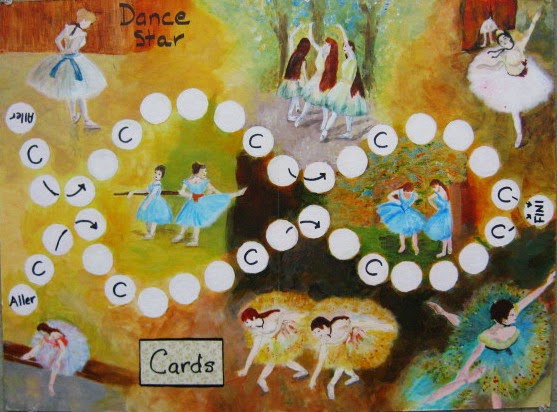
How to make this up- The final project this semester will be to design a board game based on the art of a historical fine artist. Like any board game, there should be some kind of game path that players must follow, and the design should include a title. However, all the other visual elements must be taken directly from the work of your chosen artist. You will create your own composition using the figures, objects. interiors/exteriors, colors and textures previously used by your chosen artist. The project will be painted on a piece of matboard, which provides a smooth, sturdy surface to paint on and will allow the finished piece to be folded like traditional game boards. Below are two student examples from previous semesters. Additional student examples, the full requirements, and the example that I made can be found here.
Dance Star
Edgar Degas
Painted Dreams
Vincent Van Gogh
Homework- This game board final project is due at the beginning of class on December 22, 2014.
The limited palettes graded project is due at the beginning of class on December 15, 2014.
Museum papers can still be turned in for partial credit before the end of the semester.
For next class 12/15/14- After a critique of the limited palettes project you'll have most of the class to continue working on the Final Project. We will also likely set aside some time for the class to take a short assessment test, not part of your semester grade. Bring whatever materials you need to work on whatever you plan to work on.
Today's Class- Today the class worked on the final still life assignment and final portfolio exercise of the semester. We started by looking at some slides of historical examples of still life, discussing the various purposes such pieces served in art and society. Then I set up a still life involving colorful objects and had the class paint it, considering all the aspects of still life drawing that I've stressed to this point, plus trying to match colors as closely as possible. We also looked at everyone's color temperature collages, which were collected.
How to make this up- You will need to set up a still life with solidly colored objects. Then paint it on a sheet of your 18" x 24" paper using your acrylic paints. No special lighting necessary. Above is a photo of today's still life set up in VE 209, below is a student example from a previous semester that contains many of the same objects. The full instructions and additional student examples can be found here.
This is a portfolio exercise that must be completed by the last day of class to receive full credit.
Homework- The Museum paper is due on December 8, 2014. Papers will be reviewed promptly, and if I find any significant issues, students will have the opportunity to fix it and resubmit it for a better grade before the end of the semester. Papers submitted after next week will still be accepted, but as late, and papers arriving on the last day of class won't be able to be rewritten.
I've decided to extend the due date on last week's limited color palettes project to December 15, 2014. However, next week we start the final project, so I recommend getting as much done as you can this week.
For next class 12/8/14- We will start the final project of the semester. You will be creating a new artwork based on the art of a fine artist of your choice. The artist must be of historical significance (museums, art history textbooks), two dimensional (paintings, drawings, prints) work representationally (no total abstraction), and using color. Therefore you should bring with you a book with color images of work from this artist. (large images from a book will be easier to use than tiny images from a smart phone) If you don't have a particular artist in mind, perhaps a book of a particular period of art history, or if nothing else, a general art history textbook to get you started.
You will be painting the project on matboard, the smooth stiff cardboard used in framing. It's generally available in art supply stores, and is usually stocked at the college bookstore, but I suggest you check that before next Monday. A piece between 15" x 20" and 18" x 24" will do. Standard size full boards are usually 30" x 40", but some stores carry smaller ones. If not, get the full size, we can cut it down, and there's a good chance a few of your classmates will still need one. Also bring pencil and eraser, and all the painting materials you've been using the past few weeks.