Tuesday, April 29, 2014

Images for Final Project 4/29/14


The Final Project will require creating a large sculpture.  The process will begin with sketches, and then expanding one of the sketches into a small 3D bristol board model.  The subject must be a living thing.


The last part of the project will be to build an inflatable sculpture based on the model, using clear plastic drop cloths and plastic sealing tape.  The final piece should be at least 8 feet in one dimension and must include articulated projections.  You may work in groups of 2 or 3 on one inflatable piece.  You will have the next two weeks to work on it as well and it will be due the last day of class.  Below are examples of pieces made in last semester's class.


Tuesday, April 22, 2014

4/22/14 3D Design


Today's Class-  We opened today by looking at completed projects, particularly the natural found objects pieces that were due today, but also any back projects that had come in , such as book sculptures or plastic found objects.  The rest of the day was spent working on a portfolio exercise, a sort of a continuation of last week's proportions exercise, this time involving creating an environment for the figures.  I also collected and reviewed museum papers, letting students know what needed to be done in order to complete the assignment.


How to make this up-  We started by looking at slide examples of installation art involving figures, specifically examples from  Edward Keinholz and New Jersey sculptor George Segal, each creating environments for life size figure sculptures.  You need to select some portions of our classroom to reproduce at the same proportions as the first constructed figure, the one that looks like the figure in the original photo from last week.  You need to make one major piece of furniture, such as one of the work tables, or one of the big power tools (table saw, drill press, etc), a cabinet, a portion of the wall with a specific feature (chalk board, doorway)  If you make the work table, include the top, the base, and one of the mounted vice clamps; if not the work table, bring what you make to a similar level of detail.  Also make one small piece of furniture, such as one of the stools.  

The furniture/classroom pieces should be to the same scale, and should be of the same scale as your figure.  You need to decide how tall your figure is.  The tops of our tables are 5' 6" long, a very typical human height, so if you make that your figure's height, you have a handy measuring resource.  Some students used their own bodies, standing next to items and noting where parts lined up with knees, hips, etc.  Construct the pieces using foam core, and when showing it, include your first figure in the created environment.  Above are examples created last semester, a project that required two major pieces of classroom, but you only need one and the stool for today's assignment.

This is a portfolio exercise that must be made up by the last day of the semester to receive full credit.  You may need to wait until next week to gain access to the classroom and select what parts you'll be reproducing.

Homework-  Nothing new, but anyone who still owes a back graded project or the museum paper should get them done as soon as possible to receive partial credit.

For next class 4/29/14- We will be starting on the Final Project of the semester, where we'll take something from sketch, to scale model, to large three dimensional sculpture.  For the first stage you'll need a sketchbook (or equivalent paper for drawing), pencil and eraser, bristol board, scissors or knife, and suitable glue.  


Tuesday, April 15, 2014

4/15/14 3D Design


Today's Class-  Today we talked about the idea that cultures often establish a set of idealized proportions for portraying the figure.  Sometimes it's very rigid, like the 18 fists = 1 body ratio favored by the Ancient Egyptians, or just advocated by influential artists, as in the varying head to figure ratios found in different phases of Classical Greek sculpture.  I also showed a few examples of this in two dimensions, such as the extreme distortions of the late 15th century Mannerist painting and some contemporary advertising.  Then the class worked on a portfolio exercise involving varying proportions of figures, which will be the starting point of something we do in class next week.  We also did the course evaluation forms.


How to make this up-  Start with an image of a full figure.  It can come from art history, but most students just got one from advertisements from a pile of magazines there in the classroom.  Can be male or female, but should be standing and we must see head to toe.  You will construct two figurines based on the chosen image.  For the first one start with a piece of foam core of the same proportions and pose, and then glue pieces of bristol board around it to approximate the assumed 3D proportions of the figure.  Use educated guesses to create parts of the body we don't see directly, such as partially hidden limbs.  It needs to stand on its own, so if it doesn't, you can fix it to base.


Above is an example of a reproduced figure in progress, bristol board adding roundness to the flat core.  When the first one is done, you need to create a second figure based on the same source, but this one with specific parts of the body changed to different extreme proportions.  Below is an example from today, the figure on the right being the original, the one on the left the altered version.  Additional student examples from a previous semester, as well as the specific alterations to make, can be found here.


This is a portfolio exercise and must be made up by the end of the semester to receive full credit, but the original scale figure is needed for next week's assignment, so get that one done by then.

Homework-  No new graded project this week, but the natural found objects assemblage and the museum paper are due next week.  Students who still owe the plastic found object project or the book sculpture should turn them in as soon as possible for partial credit.

For next class 4/22/14- We will continue with an exercise related to proportions.  Bring the first figure from today, sheet of foam core, pencil and eraser, sketchbook or notepad, x-acto knife, and glue.  

Tuesday, April 8, 2014

4/8/14 3D Design


Today's Class-  Today we began a new graded project involving found object assembly, but unlike the plastic (manufactured) version from a few weeks ago, this time the requirement was all natural materials.  I showed few slides of cave art, including figures and animals carved from stone, wood, bone, antlers, and other materials available to, and workable by, people of that time.  The subjects of these pieces often took forms that resembled the shapes of the materials.

How to make this up-  In class today I provided an assortment of shells collected from my local beach, and dried bamboo from a grove behind my home.  As with the coffee trays, I asked students to take some shells, consider the shapes and what they might resemble, and then come up with an idea of what might be made from them.  Also available were small pieces of wood from the scrap boxes in the room, and some went out foraging for stones, or brought in things from home, such as pine cones, twigs, etc.  Our one nod to the 21st century was to allow hot glue to be used to assemble things.  

Since the most common subjects of the cave period were human figures or animals, your subject must be one of those. They can be whole, a recognizable portion (such as a human hand, an animal's head), or even a mythological creature (human animal hybrid, unicorn, etc).  They don't have to be anatomically accurate, but recognizable to average person.  All materials must be found in nature, and can be used whole or broken up.  Wood can be carved.  At least one of your materials must be something hard (not easily carved or modeled) like stone or shells.  Although not required, paint may be used on the sculptures if you want.  Below are some student examples from a previous semester:


Above, a bull made from classroom wood scraps, shells, and bits of bamboo.  Below, a spider made from acorns and sycamore seed pods.


Additional instructions and student examples of this project can be found here.

Homework- This natural found object graded project is due at the beginning of class on April 22, 2014.

The book sculpture project begun a few weeks ago is due at the beginning of class on April 15, 2014.

The museum assignment is due on April 22, 2014.

For next class 4/15/14- We will return to using foam core and bristol board, with an exercise and project involving proportions.  Bring those items, plus scissors or x-acto knife, glue, and pencil and eraser.


Tuesday, April 1, 2014

4/1/14 3D Design


Today's Class-  Today was a continuation of last week, continuing work on the book sculptures.  We also devoted some time to critiquing the found object (plastic) assemblage sculptures, which were graded and returned.  We also were given a new water collection system for our ceiling leak.  They haven't stopped the leak itself yet, but they are looking into it.


How to make this up-  The specifics of the assignment and some student examples can be found at last week's blog post.

Homework-  The book sculpture graded project is due at the beginning of class on April 15, 2014.

The museum assignments are due on April 22, 2014 for those who want to get the maximum points available.  Paper will be accepted at dates after that for partial credit.

For next class 4/8/14- We will be starting our second assemblage project, this one using exclusively natural materials- things not created by humans.  I will provide an assortment of sea shells and bamboo pieces to get everyone started, and you'll have to gather whatever else you might need on your own.  Last semester, students continued their pieces using such items as stones, wood, acorns, seed pods, leaves, and pine cones.  You may bring such things with you to class, or add them later when you continue work on the projects on your own time.  Bring hot glue sticks, the one artificial material you will be allowed to use.

Tuesday, March 25, 2014

3/25/14 3D Design


Today's Class-  Today we started a new project using a new material for the first time. a traditional codex, or a book with a spine with pages bound on one side.  You will be carving the block of pages to create a contained sculpture.  As for the above photo, if you were there you know what that was about.

How to make this upThe rules include that the book must be able to still close and open normally, that all pages must remained partly attached to the original binding, and that no glue can be used.  Besides that there are two options, and I have good student examples of each below:

A) Positive Shape Form-  


For this option you will be carving away what you don't want to create a positive shape or arrangement of positive shapes.  (a scene, for example)  You may use the whole block of pages as your starting point, or create something that extends onto both covers.  In this portrait piece, all the dark shapes shown are shadows created by light in the classroom.


B) Negative Shape Form-


For this option, you would need to think more in terms of negative space.  Divide the whole block of pages into roughly 4 equal sized thicknesses.  You will create shapes that change, alter, disappear, and newly appear between the different sections.  For example, of the shapes that start cutting through the first section, some must continue through to the second section, while some most stop, but new negative shapes must be revealed as viewers continue to move through the book.  Those shapes must remain connected to themselves, a continuous void, but can change dimension from beginning to end.  Above is a view inside the front cover, below we can see how the negative shapes on the right side have started to change from the ones on the left.


This example uses abstract geometric shapes, but if you have an idea for doing this process with a representational scene, that is also acceptable.

This book sculpture graded project will continue in class next week.  Due date will be announced by the end of next week's class.

Homework- Nothing new, but I did review with some students which items that they still need to turn in.  Exercises can be done at any time, but there is a time factor in the graded projects, so those should be completed as soon as possible.  

I also reminded people today that the museum assignments are due on April 22, 2014, about one month from now.  I recommend getting the visit out of the way soon, before all your classes start hitting you with other papers, projects, and tests.

For next class 4/1/14-  We will look at the found object (plastic) sculptures that we started in class last week.  They will be critiqued, graded and returned by the end of the day.  The rest of the class period will be devoted to continuing work on the book sculpture project, so bring back the books you were working on, knives, and anything else you might need.


Tuesday, March 18, 2014

3/18/14 3D Design


Today's Class-  Today we started a new graded project involving found object assemblages.  Found objects are any existing materials, but for this project we are limiting ourselves to manufactured items originally created for some other purpose.  Most commonly used are plastic and light metals, but items made from rubber, glass, cloth, paper, and electronic parts may be of use.  Hot glue is the most common way of attaching things, but you may use wire, nuts and bolts, or anything else you can think of.


How to make this up-  You will need a supply of found objects.  Some students brought an assortment with them to class, and I had a small supply of items I had collected from my house, mostly plastic caps from soda bottles, milk and orange juice containers, parts of containers for toiletries, bread bag closing tabs, and starter plant label tabs.  Some start with an idea of something they wish to make, while others just put together a big pile of cast off plastics and look to see if they are inspired to make anything.

As for the assignment, you are to make a representational sculpture, something that resembles a recognizable subject in terms of overall shape and proportion, as well as color and texture.  It must be at least 12 inches in at least one dimension (height, length, diameter, etc).  Your representation can be life size or an enlargement.  I posted examples from a professional artist of this style of work on the previous blog post, and further instructions and student examples from last semester can be seen here.  Above (snake) and below (cupcake) are pieces in progress from today's class.


Homework-  This found object sculpture project is due at the beginning of class on April 1, 2014, at which time they will be critiqued, graded, and returned.

Students who still owe back projects and portfolio exercises should try to completed them as soon as possible, especially graded projects, which lose points for each week they are late.

For next class 3/25/14- We will start a new graded project involving creating three dimensional sculptures from discarded books.  Bring two old books you don't mind cutting up (one for the project, and a spare in case you mess up the first one), preferably hard cover, at least 300 pages, and with cover dimensions about 8"x 6".  ( a little larger is fine, but you don't want to get much smaller)  A few pieces of foam core, or even scraps of corrugated cardboard, of the same dimensions may be helpful for working out ideas before you start cutting up the book.  You will also need a pencil, your x-acto knife and spare blades are recommended (dull blades tend to tear paper rather than cut it).


Tuesday, March 4, 2014

3/4/14 3D Design


Today's Class- We opened by looking at the foam core relief panels projects, which were graded and returned by the end of the day.  Most of the class period was spent working on new portfolio exercise creating sculptures from parts of pulp cardboard coffee trays and similar materials.  The last part of class was spent talking about our next graded project, found object sculptures made from discarded plastic and metal objects.


How to make this up-  Get yourself 3 or 4 of the molded pulp cardboard trays available wherever a lot of take out coffee is sold.  These are designed specifically to hold coffee cups, but also have very complex shapes, with concave and convex curves and spaces top and bottom, and interesting transitions from one part to another.  Spend a few minutes carefully looking at the trays, and consider what you might do with the various shapes.  When you are ready, start to cut them into pieces with your scissors or x-acto knife, and then assemble the pieces into a sculpture.  You may make a representative object, or just create an abstract design.  The important thing is to take advantage of the shapes available to you.  Above are two examples from today's class.  Additional directions and student examples can be found here.

This is a portfolio exercise that can be made up any time before the end of the semester, but I recommend doing it soon for two reasons.  First of all, the big projects at the end of the semester will be time consuming.  Second, considering how to use the shape possibilities here will be good practice for the next major project involving cast off plastic.

Homework-  Nothing new, but those who still owe the modules project or the foam core relief panels should try to get them done as soon as possible to receive partial credit.

*******Spring Break  March 10 to 14, 2014.  No class next week*******

For next class 3/18/14- We will start our next graded project, found object sculptures making use of cast off plastics, metal, and other manufactured items.  Below are several examples of such sculptures made by New Jersey artist Lisa Bagwell.  Her materials are all things she finds as garbage or has given to her by friends who are familiar with her art.


Above and below are two views of a piece based on a sub sandwich.  The bread is made from wine corks, and the filling includes plastic lids, gloves, disposable plastic razors, and sponges.  The olive on top is made from plastic bottle caps.  


Above is a bird made largely from starter plant label tabs, a conch shell made from plastic cigar mouthpiece tips, and an ice cream cone that includes popsicle sticks, bottle caps, and a plastic spout.  Some of the same materials were used below for the hawk in a cork tree.  


The egret below is largely made from plastic utensils and pencils.


The shapes and colors of your found objects must be part of the design.  You can arrive to class with a plan, or just bring a bunch of stuff and see what it can be when you get there.  Bring your supply of found objects, hot glue gun and sticks, and anything that you might use to build on or fasten it.  Also consider what will form the main volume of your object that the surface colors and textures are attached to.  The resulting sculptures must be at least 12" in one dimension and resemble the subjects in terms of proportion, shape, and color. 

More 3D Class examples for 3/4/14- plastic


Examples of representative sculptures made from manufactured found objects.  


Above  and Below- Assorted Sculptures from
artist Lisa Bagwell


Above and Below- pieces from
previous 3D students


Tuesday, February 25, 2014

2/25/14 3D Design


Today's Class-  I opened today with a few dozen slides of 20th century art, work that emphasized planes- relatively flat surfaces and their movements.  I also had a few slides of art that took on motorized vehicles (trains and automobiles) as subject, as an introduction to today's exercise.  The rest of the class period was spent working on the exercise, using foam core and bristol board to build a simple model of a car of the student's choosing, and then an abstract sculpture using identical copies of all the same parts.


How to make this up- Choose any car you like based solely on its appearance.  Can be any make, model, or age.  Using photos of the car from multiple angles, reproduce the car's basic shape, with an emphasis on the exterior surfaces.  As you make each piece for your car, make a second identical piece and set it aside.  Once you've completed the car, use the second set of pieces to build an abstract sculpture of your choosing, any form that doesn't look like a car.  Above is an example from today's class.  More detailed instructions, and additional student examples, can be found here.

This is a portfolio exercise and must be completed by the end of the semester to receive full credit, but I suggest finishing it soon.  After spring break the projects will be bigger.

Homework-  The two foam core relief panels begun two weeks ago are due at the beginning of class on March 4, 2014.  

Reminder- deadline to withdraw from classes is March 4, 2014.  Students still on the roster after that will remain in the class and get the grade they earn.  Students who stop coming to class at that point, and thus stop turning in work, will fail.

For next class 3/4/14- We will open with a group critique of the foam core relief projects, which I will grade and return.  Then we will be doing another portfolio exercise involving complex shapes.  Bring 3 or more cardboard pulp coffee tray/holders, scissors and/or x-acto knife, and glue.  If you would prefer to use hot glue, we have guns, but you'll need to get some hot glue sticks.

Tuesday, February 18, 2014

2/18/14 3D Design


Today's Class-  Due to what I believe was the fourth snow since our last meeting, Kean University scheduled a delayed opening for 11:00 am, and I decided to delay it a little further to noon, to make sure everyone, including myself, would have time to get there.  As it turned out, the travel conditions were better than expected and I was on campus at 11:00, and students started showing up after 12:00.

With only a half day to work with, and a very reduced number of students, it didn't make sense to start the planned car-related exercise.  So today those present were able to continue working on the foam core relief project we started last week.  

How to make this up- The instructions and details for the foam core reliefs project can be found in last week's blog post.  It has been updated to include images of my examples of the initial skeleton piece, and a second relief on another thing with similar proportions and motifs in the positive and negative relationship.

Homework- The pair of foam core relief panels is due at the beginning of class on March 4, 2014.  

For next class 2/25/14- We will go back to the planned outline and do a portfolio exercise related to the concept of surface planes- the car assignment.  Bring images from multiple directions of an automobile that you like specifically because of its physical appearance- any style or age is fine.  Also bring  a sketchbook, pencil and eraser. foam core, bristol board, x-acto knife and scissors, and white glue.


Tuesday, February 11, 2014

2/11/14 3D Design


Today's Class- We opened with a group critique of the Make 100 Module project.  These were graded and returned by the end of class.  After that we looked at several slides of art featuring negative space and relief elements, then started our next graded project, using foam core to create relief sculpture.  

Below is an example of using foam core in this process.  It is a different project from today's but it gives an idea of what it can look like- a broad piece of foam core with a layer of cut and shaped pieces glued over the top to create a relief sculpture surface. The areas that have been cut become negative spaces in the composition, and the raised areas become the positive shapes.  In both two dimensional and three dimensional art, positive and negative spaces are equally important.


How to make this up-  For the new assignment you will need two 12" x 12" pieces of foam core, which will be the bases for two relief sculptures.  We are going to use skeletons for the starting point of the first one.  Skeletons are successful design, evolved over millions of years to help support and protect the owners of that framework.  The bones can be thought of as positive shapes, and the spaces inside and between are negative shapes.  I distributed photocopies of skeletons, a mixture of student drawings of human skeletons and book illustrations of animal skeletons, although students also had the option of finding one on their own.  Below is one of the human skeleton images that were available.


Below is a demonstration piece I started today using that drawing, concentrating on the area of the rib cage.  The resulting relief piece is not medically accurate, but maintains the positive/negative relationship of the original.  Your relief composition should use the entire 12" square base.   As in my example, you may choose a small piece of the skeleton and enlarge it.  My sample is using all white foam core, but some students have requested to use both black and white, one for the base and the other for the raised relief elements, and that is fine if you like the idea.


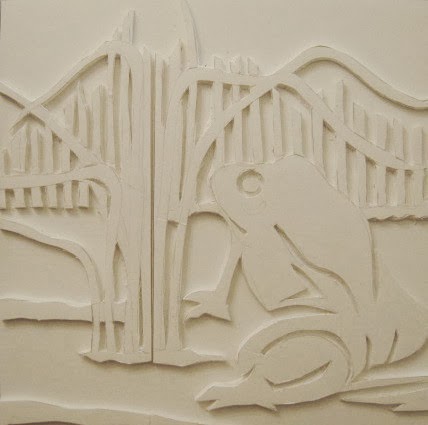
For the second piece, you will select something different to depict.  It can be a living thing or inanimate object, or even a scene with multiple objects, but your subject should be something that normally has some three dimensional quality.  I suggest you start by sketching the composition on paper first.  For the second relief sculpture, create a design with a breakdown of positive and negative shapes with a proportion similar to the skeleton piece.  The shapes need not have any relationship to bones, though that is an option if you like.  In my second piece below (frog on the ground near some plants) I have several long curved crossing elements, which echoes movements in the rib cage, and the frog includes shape that relate to the skeleton's shoulder blades.


Homework- The two panels of this graded relief assignment are due at the beginning of class on March 4, 2014. 

Semester Schedule Change-  

Although we have not yet missed any class time due to the winter weather, it's requiring me to rearrange the planned schedule for the semester.  The graded project originally scheduled to start in two weeks requires me and you to gather materials found in nature, and right now everything outside is covered with a thick layer of snow and more is on the way.  We will still do everything planned on the syllabus, just in a different order.  Here is the new plan going forward:

Week 5  Planes and movement
Week 6  Complex contour surfaces (coffee holders)
Week 7  Textures and colors from life (found objects)
Week 8  Changing points of view (found objects)
Week 9  Changing points of view continued
Week 10 Forms in nature (found natural objects)
Week 11 Proportions (foam core/bristol)
Week 12 Proportions continued
Week 13 Begin Final Project
Week 14 Final Continued
Week 15 Final critique/all work due

I'll provide reminders each week regarding the required materials.

For next class 2/18/14- We will look at the use of planes (surfaces) in sculpture in a portfolio exercise.  You will need to bring to class images of a favorite automobile from a purely exterior design perspective.  Last time I had a class do this most went with sports cars or pick up trucks, but any style or vintage is acceptable.  You should have photos of the vehicle from different sides, to aid you in building a simple model of your car, which will lead us to the second, more abstract half of the design exercise.  Bring a piece of foam core, bristol board, sketchbook and pencil, scissors and/or x-acto knife, and glue.

Tuesday, February 4, 2014

2/4/14 3D Design


Today's Class- We started today by reviewing some textbook definitions of sculpture, including various processes used.  We then moved on to a discussion of the concept of symmetry and asymmetry, and examples of how they are used in three dimensional art.  That was the starting point for a portfolio exercise that dealt with those concepts.  We also took a walk over to the Bamboo show in the Burger Gallery, since it is relevant to some projects we'll be doing later this semester.


How to make this up- Students started by thinking about objects that demonstrate symmetry, and selecting one to turn into a three dimensional sketch made from bristol board.  Above and below are two student examples from today's class.  The specific requirements for this assignment, as well as additional student examples, can be found here.

This is a portfolio exercise, which must be made up by the end of the semester to receive full credit, though it's recommended you do it soon to get experience with the materials that will help when working on other projects.


Homework-  The Make 100 Modules graded project is due at the beginning of class on February 11, 2014.  If you haven't yet seen the Bamboo show at the Burger Gallery in the CAS building, I recommend you do so before it closes on Friday.

For next class 2/11/14-  After a critique of the first graded project we will begin the second, which will make use of the idea of relief sculpture.  Bring two small size (20" x 30") pieces of white foam core, x-acto knife and spare blades, white glue, a sketchbook, and pencil and eraser.

Tuesday, January 28, 2014

1/28/14 3D Design


Today's Class-  Today we began our study of 3D design.  We opened with a brief discussion of the nature of three dimensional art, and how it differs from two dimensional art, as well as overviews of materials and processes. The museum assignment was distributed and reviewed.  Most of the day was spent working on our first graded project of the semester, a sculpture built from 100 identical three dimensional modules made from bristol board.


How to make this up-  The first step is to create the modules.  I brought in a few sample pieces and had students sketch out ideas and then produce a prototype of one of their ideas with bristol board.  Once that was worked out, they started making identical copies, with the goal of making 100 of them.  The project will be completed by gluing the modules together to make a single sculpture, as in the example above.  The specifics of the assignment, as well as additional examples of completed student projects from previous semesters, can be found here.

Homework-  This 100 module graded project will be due at the beginning of class on February 11, 2014.  

For next class 2/4/14- We will look at more formal design issues and complete a portfolio exercise related to ideas of symmetry and asymmetry.  Bring your sketchbook, pencil and eraser, a few sheets of bristol board, scissors or x-acto knife, white glue, and two sculptural bases (simple stiff boards such as form core or mat board) about 8" x 10". 


Tuesday, January 21, 2014

1/21/14 3D Design


Today's Class- Today was the first meeting of the semester for our class.  Despite the winter weather, most of the students on the roster were able to make it in.  With snow already falling and more on the way, we kept it short and to the point.  I distributed the syllabus and reviewed its contents with the class.  Then I had the class fill out a survey of their art backgrounds, which we discussed as a class.  I used the same form to talk about my own background in art, including three dimensional.

How to make this up-  Students who missed today's class should just come next week, assuming we don't have another Tuesday snowstorm.  (it has snowed on the last three Tuesdays of the spring and fall semesters)  

Homework-  Nothing yet.

For next class 1/28/14- We will start our study of three dimensional design.  I will discuss some of the basic principles, and we will begin the first project of the semester.  Bring a sketchbook and pencils, three full size (about 18" x 24") sheets of bristol board or the equivalent amount of smaller sheets, scissors or x-acto knife, and white glue.  Masking tape may be helpful for holding things together during the gluing process.


Friday, January 17, 2014

Welcome to the Spring 2014 Semester

This is the blog that I have set up for my classes at Kean University.  To avoid confusion with other classes I teach here, the text for all postings specific to my 3D Design class will be in orange text.  Postings for general purposes will be in black text.

Each week I will post information about the class.  This will include a detailed description of the projects done or started that day, and of any homework.  Photos of completed versions of those projects will be included if applicable and available.  I will also include any due dates and the list of materials needed for the following week's class.  The title of each post will be the name of the class and the date of that particular class meeting.  About a month's worth of class meetings will appear on the main page, but postings from classes earlier in the semester can be found by using the archive function in the right hand column.  

This blog will be useful for anyone who misses a class for any reason.  Some students may even make up the missed work before the next class meeting.  But even students who never miss a class take advantage of it- to get more homework information, to see student examples of the assigned projects, to get a reminder about what they need for the next meeting.  It's available 24/7 without having to wait for me to reply to your e-mail.  Of course, if you have a question that isn't answered by what is posted here you are welcome to e-mail me and I'll get back to you as soon as I see it, usually within the day.